
Awards
Documentation
Award of Excellence
A Documentation Award of Excellence is given to the exhibition Seeds of Regionalism – The Clauss Legacy: Early Modernism in the South. In 1939, Alfred and Jane West Clauss began designing homes along an undeveloped ridge in Knoxville, Tennessee. Known as “Little Switzerland,” it became the first modern deed-restricted subdivision in the United States. The houses preserved mountain views, responding to the steep topography while adapting to East Tennessee's climatic requirements. Drawing on their early work—Alfred with Mies; Jane in Le Corbusier’s Paris atelier—the Clausses translated the International Style into a place-based language. The exhibition pulled together an archive scattered across institutional collections, family holdings, newspapers, and oral histories. The design of the exhibition itself reflected the spatial logic of the Little Switzerland houses, aligning media, models, and furniture with the existing gallery's modular structure, allowing visitors to experience the Clausses’ work through scale, material, and proximity. Its visual language drew from the Clausses’ graphic output, including their work for the Tennessee Valley Authority, the Civilian Conservation Corps, portable housing, and wartime posters. Original furniture, lightly restored, demonstrated how their ideas about modern living shaped daily environments. The closing memory wall featured an oral history video of family films, photographs, and interviews, allowing the architects to narrate their own story. The exhibition strengthened the case for a National Register listing and showed that modernism can be universal yet deeply rooted in place.
“The project recovers an underrecognized early modernist legacy in the Appalachian South and demonstrates exhibition-making as documentation. Its methodological rigor, attention to design as public education, and expansion of the modernism canon beyond coastal centers is worthy of recognition.”
Knoxville Museum of Art
John L. Sanders, FAIA, Co-curator: Model Fabricator & Team Lead; Richard-Allen Foster, AIA, Co-curator: Lead Exhibition Design & Author; Kelsey Conley, Knoxville Museum of Art Assistant Curator; Natalie McLaurin & Knoxville Museum of Art staff, Exhibition Coordination and Installation; Robert Fuhrig, Furniture Restoration and Exhibition Specific Fabrications; Benjamin Pollak, Research and Grants; Anja Cordell, Site Model Base and 3D Printed Site Models; Parker Greene and Michael Burkey, 3D Printed Site Models; Bruce Cole, Photography

Case Study House No. 21
Lorem ipsum dolor
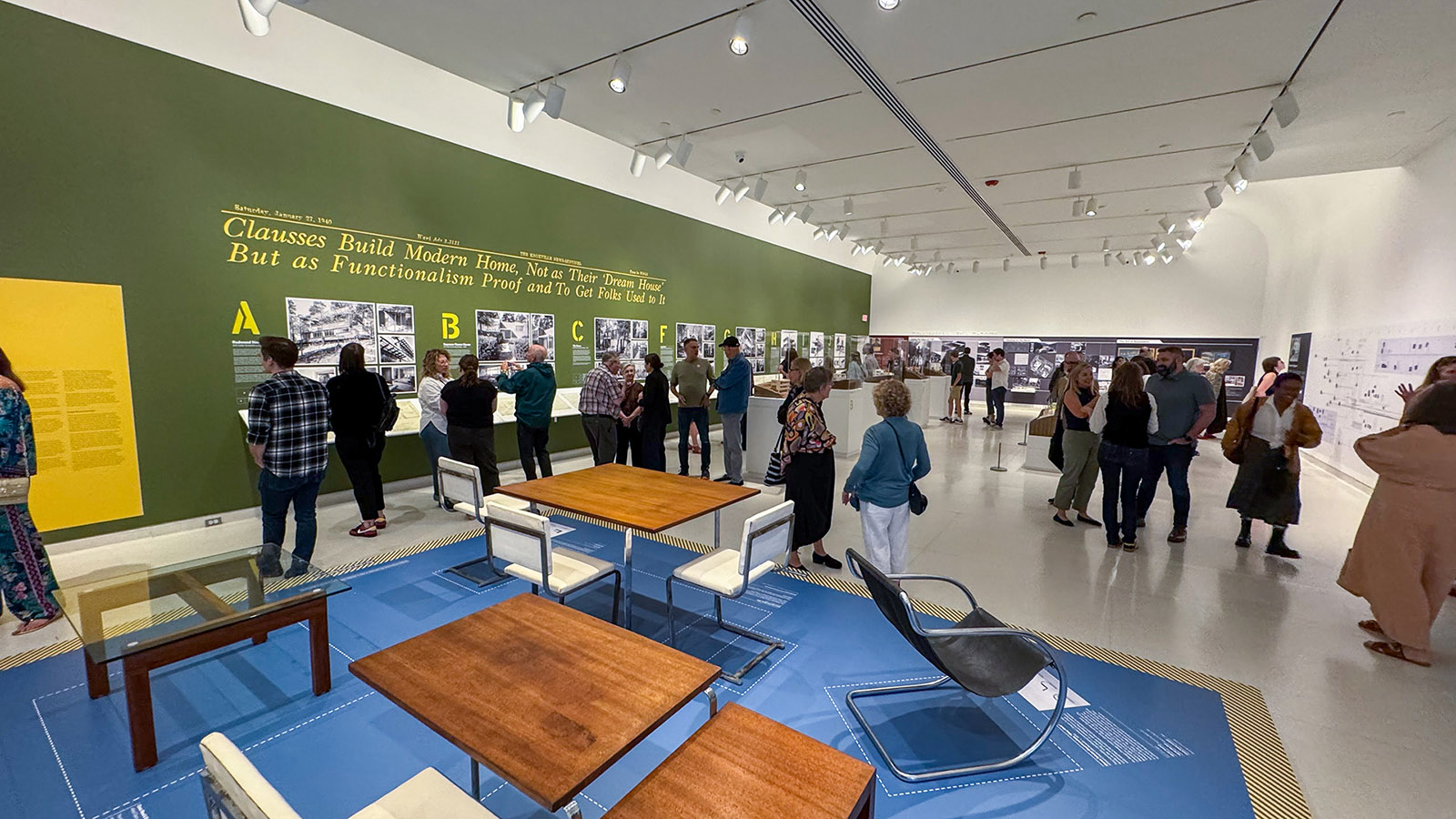
Seeds of Regionalism - The Clauss Legacy: Early Modernism in the South exhibition. Knoxville Museum of Art.
Bruce Cole