
The following remarks by Paul Goldberger were presented during the roundtable session, "Advocating for the ‘-isms’: Late-Modernism, Postmodernism, and Brutalism," during the 19th International Docomomo Conference in Los Angeles.
“I suppose all architecture has to die before it can touch the historical imagination,” John Summerson wrote in The Unromantic Castle, by which he meant, of course, that everything goes through a period of being misunderstood, disrespected, or disliked before it takes its proper place in history.
Docomomo was created out of a recognition of this fact, out of an understanding that modernism was in its period of temporary death, before it had “touched the historical imagination,” as Summerson put it, and that we were at great risk of losing buildings that in time would be considered significant, sometimes even great, but in any case worthy of preservation, but that would have been destroyed because people didn’t know or care enough about them: relatively recent architecture that Docomomo’s founders knew was distinguished, but that the general public did not understand or respect. Advocating for “difficult” architecture was an essential part of Docomomo’s founding mission.
Remarks by Paul Goldberger at 19th International Docomomo Conference
Author
Paul Goldberger
Tags

Zonnestraal Sanatorium, Hilversum, The Netherlands, 1928-1931. One of the threatened sites that sparked the formation of Docomomo. Original design by Johannes Duiker and Bernard Bijvoet; Later restored by Bierman Henket Architecten and Wessel De Jonge Architecten
Credit:
Courtesy Docomomo Portugal

The TWA Flight Center, designed by Eero Saarinen & Associates and built in 1956-62, was one of the early advocacy issues of Docomomo US and Docomomo US/New York Tri-State.
Now, as the architecture that Docomomo was established to protect recedes further into the past, and becomes not a recent style but a historical style, recognized by more and more people as a full and significant part of our architectural heritage, what about the architecture that followed it? What about those architectural expressions that right now represent what modernism once did—something that we need to educate people about and that we need to preserve, but that is not yet widely understood or recognized as important by enough people, and that needs special help and support? Isn’t providing this support what “Preserving the Recent Past” should mean?
We have already seen Docomomo move from what might be called orthodox modernism to embrace brutalism (at least somewhat!) and I would argue that we need to continue, to move forward as time itself moves forward, and not to become the modernist equivalent of the Victorian Society, devoted fully and exclusively to the protection of one kind of architecture, but to continue to protect that which is in Summerson’s period of death before permanent life, to protect those things that are too new to have achieved their historical status yet, but that are good enough so that we should not risk losing them before they have the chance, to use Summerson’s words once again, “to touch the historical imagination.”

Night view of Boston City Hall west elevation and entrance from the plaza, with new lighting.
Credit:
© Anton Grassl

Lobby of 60 Wall Street, New York.
Credit:
KRJDA
I guess what I am saying is that I advocate for modernism with a lower-case m—not seeing it as meaning only the style we think of as Modernism with a capital M, the period we think of as the Modern Movement, but also of modern in the sense of being recent, new, contemporary, not yet fully established or accepted for the long time, and appropriate for protection and education both. Of course, this would include post-modernism, which in the end, as we all know, is itself a part of the history of modernism, as well as late modernism, the new formalism, and so forth. So much of the architecture of the last half century, if not the last three-quarters of a century, has been an outgrowth of or a reaction to the revolution that modernism represented, and in that sense is a part of its legacy, so I don’t think we even need to consider embracing it to be a real shift in Docomomo’s mission.
After all, post-modernism is not anti-modernism, despite some of the rhetoric that has surrounded it. It is fine not to like it—everybody has their likes and dislikes, even within the realm of orthodox modernism, or what we might even call normative modernism. You don’t have to love something to acknowledge its historical significance, or to consider it to fall within the purview of Docomomo’s mission. Taste is one thing; scholarly and historical judgment is another. I think it is fair to say that Docomomo was created to be a kind of halfway house for historical judgment, a place where architecture can be studied, investigated, and protected before it enters the larger stream of history.

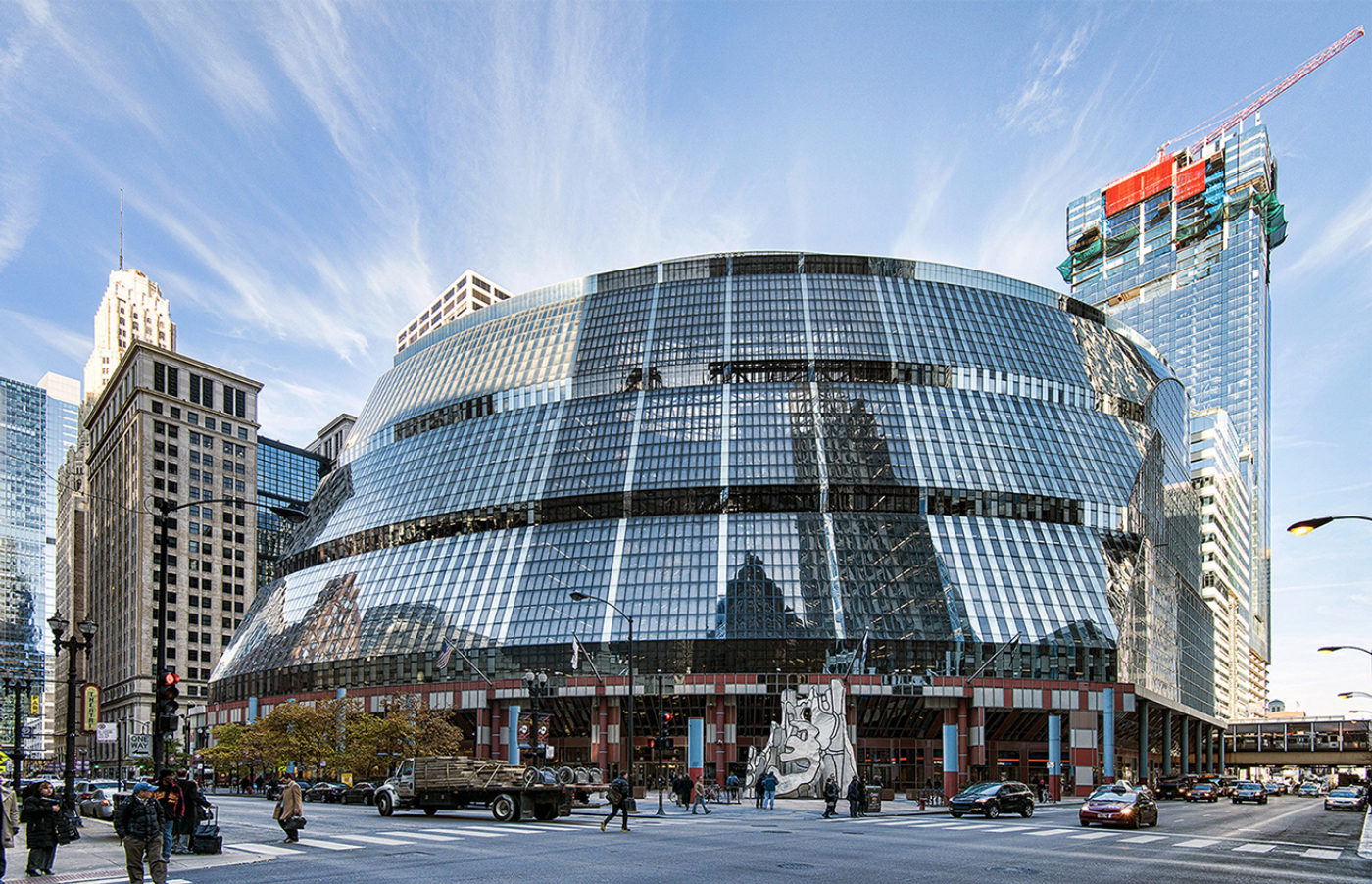
Protesters rally outside the Thompson Center on June 23, 2021, in an effort to save the building from possible redevelopment.
Credit:
Brian Cassella / Chicago Tribune
Credit:
Thumpr455 via Flickr
A final point I would make is about the futility of excessive stylistic categorization. In the end it is not a productive exercise to try and parse the differences between different schools of modernism, different periods of it, and different geographical manifestations of it—useful for the historian, surely, but in my mind not for the definition of Docomomo’s mission. Where do you draw the line between modernism, late modernism, brutalism, formalism, and so forth? They all influenced each other, and cross-fertilized each other, we could say. They are not separate and discreet periods, and neither, really, was the “Modern Movement.”
All of modernism’s manifestations in the twenty-first century remain deeply indebted to the original strains of modern architecture, as homages to it, as reactions to it, as interpretations of it. I would argue, then, that to think of the architecture of recent decades—the architecture of post-modernism and late modernism—as being within Docomomo’s mission is not to dilute or compromise that mission at all, and it is not even, really, to expand it. It is, rather, a way of being true to it, of reinforcing what Docomomo was created to do.
About the Author
Paul Goldberger, who The Huffington Post has called “the leading figure in architecture criticism,” is now a Contributing Editor at Vanity Fair. From 1997 through 2011 he served as the Architecture Critic for The New Yorker, where he wrote the magazine’s celebrated “Sky Line” column. He is the author of numerous books, including BALLPARK: Baseball in the American City, published in 2019 by Alfred A. Knopf; Building Art: The Life and Work of Frank Gehry, published in 2015 by Knopf, and also of Building with History, published by Prestel; Why Architecture Matters, published by Yale University Press; Building Up and Tearing Down, a collection of his articles from The New Yorker published by Monacelli; and Christo and Jeanne-Claude, published by Taschen. His latest book, DUMBO: The Making of a Neighborhood and the Rebirth of Brooklyn, was published in 2021 by Rizzoli, and Yale University Press published a new revised edition of Why Architecture Matters in 2023. He also holds the Joseph Urban Chair in Design and Architecture at The New School in New York City and was formerly Dean of the Parsons School of Design at The New School. He began his career at The New York Times, where in 1984 his architecture criticism was awarded the Pulitzer Prize for Distinguished Criticism, the highest award in journalism. In 2012 he received the Vincent Scully Prize from the National Building Museum in recognition of the influence his writing has had on the public’s understanding of architecture. In 2017, he received the Award in Architecture of the American Academy of Arts and Letters, which called him “the doyen of American architectural critics.” He lectures widely around the country on architecture, design, historic preservation, and cities, and has appeared in numerous films and television programs as a commentator on architecture.