
The clock tower watched over me as I paced around the construction fencing, squinting through breaks in the chain link to see torn up granite and two-by-fours wrapping the mosaic. I had spent years rolling around the lower level at Exelon Plaza on my skateboard. Memories of how the granite had felt under wheels and the sounds of boards popping up to the ledges and off the stairs suddenly weighed heavy on my mind - I couldn’t recall exactly when my friends and I had spent an evening there for the last time.
Located in the heart of Chicago’s Loop, Chase Tower opened in 1969 as the First National Bank of Chicago. The building and its plaza, now known as Exelon Plaza, occupy the entire downtown block bounded by Clark, Dearborn, Madison, and Monroe Streets. The 60-story skyscraper designed by C.F. Murphy and Associates and Perkins & Will, with its recognizable sloping base and central location, helped to establish the building as a local landmark. The building’s plaza held its own significance as a vibrant public space. Completed in 1972, Exelon Plaza had gained its own reputation as a cornerstone of Chicago skateboarding culture. In 2024, Chase released large-scale renovation plans for the building complex which included major improvements to the outdoor plaza, rendering it inaccessible to the public as of 2026.(1)
Chasing Recognition: Legacies & Imagined Futures of Skateboarding at Chicago’s Exelon Plaza
Author
Victoria Hill, Architectural Historian, Johnson, Lasky, Kindelin (JLK) Architects; Gabriel Vara, Associate, SB Friedman Development Advisors
Tags
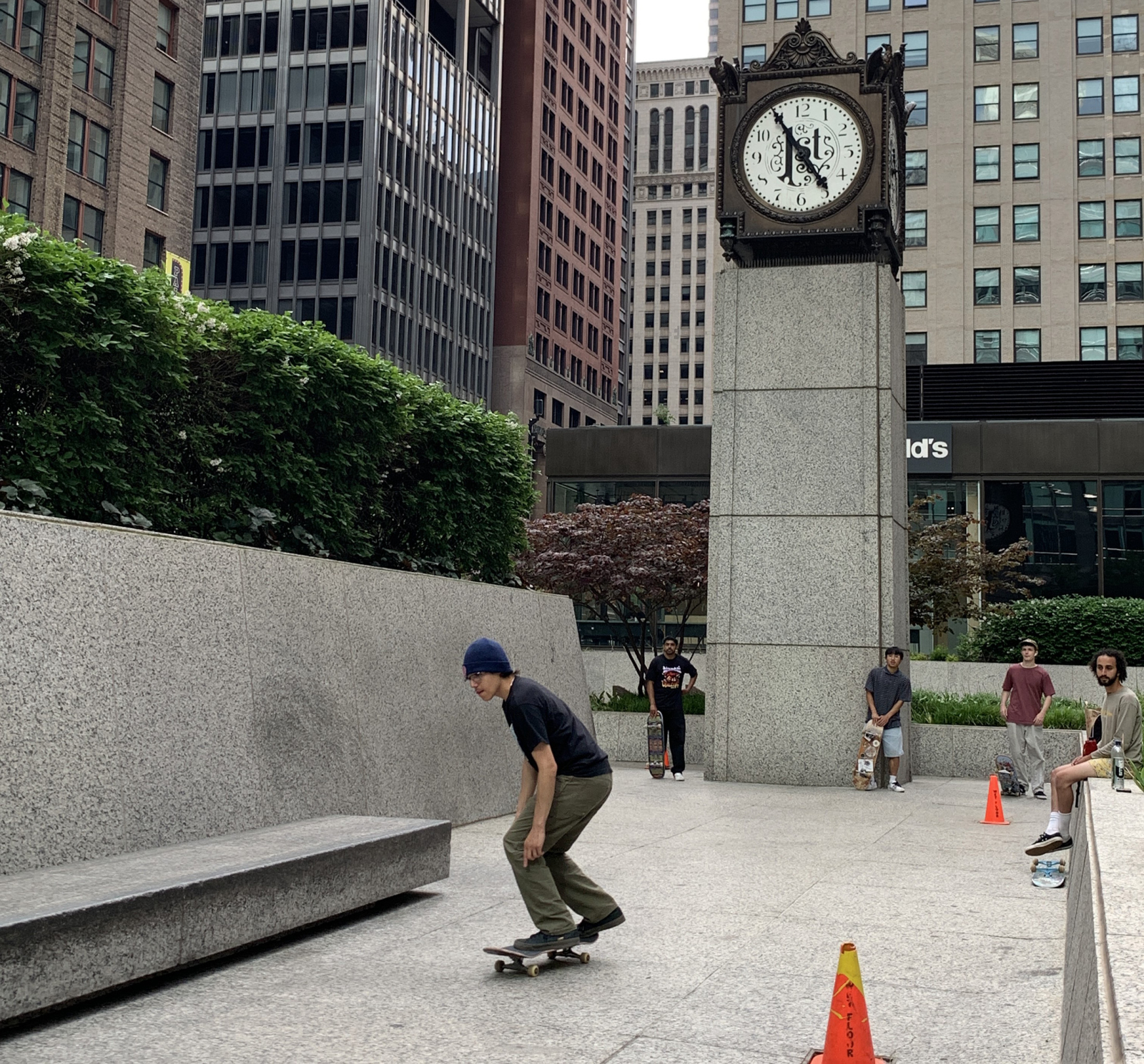

Exelon Plaza, looking west from upper plaza.
Credit:
Gabriel Vara, 2022.
I asked Andrew “G” Smith, skateboarder, filmmaker and producer at Uprise Skateshop in Wicker Park, Chicago, how he remembered the granite. “Very well,” he grinned, and he brought out a chunk of the Plaza floor that he had rescued from the construction site. While the top side was dirtied by decades of oxfords, flats, sneakers, heels, and wheels passing over, the broken stone glistened under the shop's light.
I sat with G to talk, starting with how he remembered skateboarding at Exelon Plaza. He recalled:
It [was] a fantastic spot. Many different genres of getting kicked out or being allowed to skate there, but for skating it for over 15 years, it was definitely the spot where you would start your night and end your night at. Really good run during COVID of security not caring at all - they had just given up because there would literally be skateboarders or rollerbladers, bikers, scooters, you name it, there at all times. I've been there before and there were easily over 100 people using every inch of that space in their own cliques and just vibing.
He thought back to the earliest years he remembers seeing documented: “I know people were probably doing wall rides and wallies in there in the 80s, early 90s, but I would say probably late 90s, early 2000s is when you would see definitive tricks being done because there are older videos that showcase skating.”

Andrew “G” Smith (left) holding a piece of granite from Exelon Plaza and a First National Bank of Chicago coin bank in the shape of the building, and Paul (right, surname unknown) holding a photograph of legendary Chicago skateboarder Steve Snyder, “Stevie Dread,” at the Plaza ca.1980s.
Credit:
Gabriel Vara, 2026
G explained the Plaza’s variety: “It had just every, realistically on paper, every obstacle that would make for a [skateboarding] spot between a wall ride, ledges of various heights, curbs, a flat-bar, stairs, handrails, out-ledges.” He described the attitude of skating in this type of urban environment as “raw and authentic, and more of a risk to reward scenario.”
He talked about his relationship with building security: “...It got to the point where the same security guards would be kicking you out every night, and they wouldn't be running out to get you… and then after a while, you start getting to know their names. They come to kick you out and they don't even say they're kicking you out. You just say, what's up? How you doing? What's going on today?”
He described friends made, and the olive branch he would extend when he knew there’d be a large gathering:
We would just buy a pizza and go into the building and just hand it to security and they would just look at you like you're absolutely crazy, but they just got like, a job that is absolutely thankless. So the fact that people you're supposed to be kicking out of the property are being nice to you for you just turning the blind's eye [sic] to it is absolutely insane.
G recounted a Go Skateboarding Day when the relationship was badly strained:
…There was just an out of control group of kids, probably rolling like 100 deep… And one of the kids had a can of spray paint for whatever reason. But this security guard tried to kick out the group and it was just way too many people to deal with. And the security guard turned around and was walking away to go back inside... And someone sprayed her with spray paint.
They were pissed. The spot was, like, done.
And we saw a video of it and we were mad… we all felt really bad because she was never nice to us until she needed a cigarette from someone. And we gave her, like, two.
So we all pooled in money and we got her like $200 worth of stuff, new clothes and make-up or some gift cards to some places we figured she would go to. And we gave it to her and she just broke down crying. It's just, like, something I don't think anyone would have ever done, and she just was like, ‘My life sucks, whatever.’ But the next day, the same subculture of people, but totally random dudes show up and apologize on behalf of someone we don't like.
The complicated relationship between skateboarders and Chase Tower building security is one that I had participated in for years, but my interactions with the banking company have been limited to financial transactions - app navigation or ATM usage. I asked G who he’s talked with at the company: “I've gone inside to talk to a teller before. Other than that, they keep my money for me and make money off of me. So they should be giving me a little piece of their playground for being a good customer for 30 years.”

Ongoing construction at Exelon Plaza, looking southeast from the southwest corner of Chase Tower.
Credit:
Gabriel Vara, 2026.
We took inventory of downtown public spaces:
For living in Chicago for 18 years and being downtown for a lot of that on a skateboard, the amount of places that are open access are about limited to the sidewalk in the street at this point… unfortunately, due to loitering, homeless people, and people who are not bringing revenue to businesses, you see a shift in the dynamic of who’s allowed to share the space. Multiple plazas have gotten fenced up and aren't accessible to anyone unless you're from inside of the building to go out.
And with Chase Plaza being the first one to kind of disappear, we have since lost the Thompson Center plaza, and just little by little, zones and spots are disappearing. And you look, and it also seems like a representation of downtown Chicago - looking at State Street and the Mag Mile. There's empty storefronts, nothing's going on. It's a signifier of how a community used to work, creating space for people that is useful - that makes their day more enjoyable and benefits businesses around where you can go and get a drink and this and that. But when you need to get buzzed into a 7-Eleven to get something at any hour of the day, and then the rest of the street is vacant, and the public space has gone, what are we really doing? Are we just supposed to sit at our desk and just stare at our phone?
G told me about those stubborn in the subculture, unwilling to let their spot go: “Even after the fence was up and the plaza was closed, there were still people doing tricks on it. Whether you had to hop a fence, or this, that, or the other, there was still opportunity to be there.”
JPMorgan Chase, in a February 2024 press release, declared that the property renovation project “will provide employees and clients with best-in-class hospitality and workplace experiences,” including the improved outdoor plaza and a modern food hall. Aside from employees and clients, the level of accessibility to the public is unclear. The future of the Plaza as one of Chicago’s most iconic skateboarding spots is unclear. While the company boasts the economic activity it generates, it does not take credit for creating a gathering space for this Chicago subculture for decades.(2)

Ongoing construction at Chase Plaza, looking west from Dearborn Street.
Credit:
Gabriel Vara, 2026.
Scaffolding and informational sign regarding ongoing Chase Tower and Plaza improvements. Gabriel Vara, 2026.
Chicago touts robust architectural and historic preservation networks. But Chicago, and cities nationwide need to start recognizing the subcultural significance that drives many of their community spaces. Skateboarders are often left out or dismissed from conversations around urban development despite best efforts from those within the subculture. In 2016, the Philadelphia skate community lost its iconic Love Park to renovations. Despite this, the community managed to salvage a number of the granite benches from Love Park to be reincorporated into the neighboring redevelopment of the Philadelphia Municipal Services Building. Pat Heid recounted the process of working with the city, project managers, and architects in a 2026 article from Quarter Snacks:
I put together a 24-page presentation that included the history of skating in the plazas downtown, their global reach, and how they have impacted different generations — from the early 90s to the golden era of Love, the X-Games, then the skating ban downtown, to the more recent Muni generation. They had no idea about any of it. They didn’t remember DC Shoes offering a million dollars for upkeep of Love Park — “Really? It’s crazy we didn’t accept that.”(3)

Scaffolding and informational sign regarding ongoing Chase Tower and Plaza improvements.
Credit:
Gabriel Vara, 2026.
Ten years later, the parallels are obvious at Chase Plaza as it sits shrouded by security fencing. While skateboarders will continue to build communities wherever they can stick a trick, cities stand to benefit from engaging those who really know their streets and the stories of their people. Cities across the country constantly work to activate community spaces and energize their downtowns. When a city embraces its skateboarders, urban spaces remain active outside of work hours. Restaurants and shops see more business. The playful nature of skateboarding turns the urban environment more welcoming rather than transitory and transactional.
Notes
(1) “Exelon Plaza,” TCLF, accessed July 30, 2026, https://www.tclf.org/exelon-plaza; “First National Plaza Designs Undergo Study,” Chicago Tribune, May 26, 1968.
(2) “JPMorgan Chase Unveils Major Renovation Plans for Its Chicago Headquarters at Chase Tower,” JPMorgan Chase & Co., February 26, 2024, https://www.jpmorganchase.com/newsroom/press-releases/2024/chicago-investment.
(3) “How Skateboarders Won & Got a Skate Plaza at Philadelphia’s Muni Building - an Interview with Pat Heid,” Quartersnacks, March 31, 2026, https://quartersnacks.com/2026/03/how-skateboarders-won-got-a-skate-plaza-at-philadelphias-muni-building-an-interview-with-pat-heid/.
Bibliography
“Exelon Plaza.” TCLF. Accessed July 30, 2026. https://www.tclf.org/exelon-plaza.
“First National Plaza Designs Undergo Study.” Chicago Tribune, May 26, 1968.
“How Skateboarders Won & Got a Skate Plaza at Philadelphia’s Muni Building - an Interview with Pat Heid.” Quartersnacks, March 31, 2026. https://quartersnacks.com/2026/03/how-skateboarders-won-got-a-skate-plaza-at-philadelphias-muni-building-an-interview-with-pat-heid/.
“JPMorgan Chase Unveils Major Renovation Plans for Its Chicago Headquarters at Chase Tower.” JPMorgan Chase & Co., February 26, 2024. https://www.jpmorganchase.com/newsroom/press-releases/2024/chicago-investment.
About the Authors
Victoria Hill is an Architectural Historian at Johnson, Lasky, Kindelin (JLK) Architects in Chicago, IL where she prepares nominations to the National Register, conducts historic building and bridge condition surveys and assessments, and helps project sponsors through compliance with Section 106 of the National Historic Preservation Act. She maintains professional membership with the Association of Preservation Technology Western Great Lakes Chapter (APT WGLC) and the Skyline Council of Landmarks Illinois. She is also an active member and volunteer with the Big Shoulders Chapter of the Society for Industrial Archaeology. Born and raised in the Hampton Roads area, Victoria graduated from Stanford University with a BA in Art History and from the School of the Art Institute of Chicago (SAIC) with an MS in Historic Preservation.
Gabriel Vara is an Associate at SB Friedman Development Advisors in Chicago, IL where he gathers and analyzes geospatial and real estate market data to help cities achieve a diverse range of development outcomes across the United States. He maintains professional membership with the Skyline Council of Landmarks Illinois and has been skateboarding for nearly a decade. Born and raised in Chicago, Gabriel graduated from the University of Illinois Urbana-Champaign with a BA in Urban and Regional Planning, concentrating in Social Justice and Sustainability.