Yale University Art Gallery

Commission brief: To accommodate the school of architecture in the Yale University Art Gallery building through an addition to the original gallery. The addition was to house classrooms, studios and additional gallery space.
Design brief: Kahn designed a modern addition to the original gallery to accommodate the specified program.
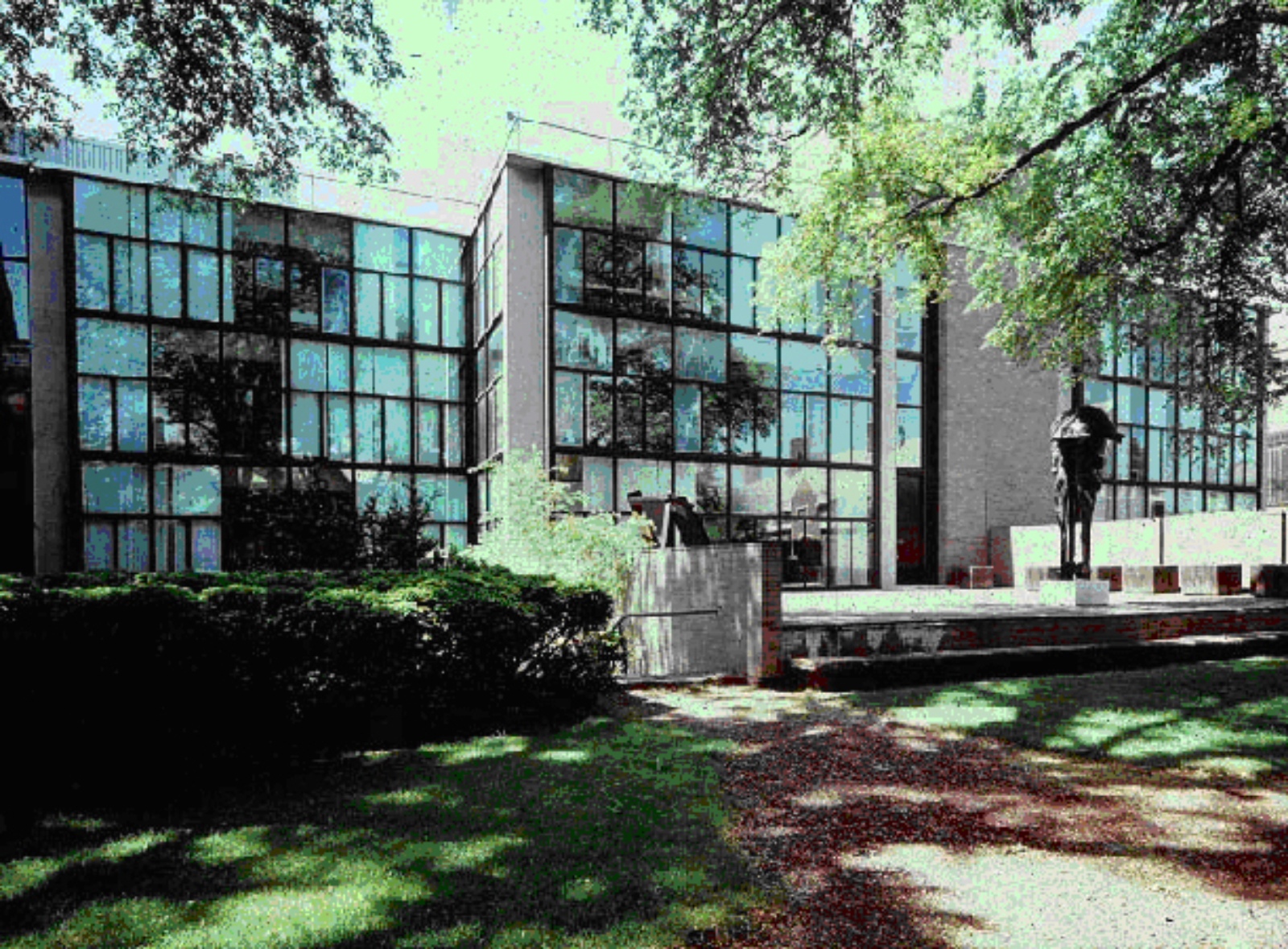
Louis I. Kahn’s Yale University Art Gallery is a simple, unadorned modern structure. The building’s overall plan is two conjoined rectangles—the larger being approximately 140 ft x 80 ft and the smaller being approximately 40 ft x 50 ft. The façade’s primary materials are glass and brick. On the northeast and northwest facades various rectangular pieces of glass interlock to form a curtain wall that does not reveal the interior frame of the building. The southwest facade is solid brick with projecting stone courses. The building is connected to the original gallery at the southeast. A sculpture court is also incorporated into the building exterior. The interior gallery space is open plan with moveable partitions for adaptability. Two stairways are centrally located. One stairway, of cylindrical shape with triangular landings, is particularly distinctive. The ceilings and floor frames are concrete, tetrahedral shaped slabs. The majority of interior materials are left unfinished—the most significant of which is the concrete walls on which the artwork is hung.
Steel beam with concrete, brick and stone
Name of surrounding building: Yale University Art Gallery (1928, designed by Edgerton Swartout)
The Yale University Art Gallery is the first time Kahn created a major structure of reinforced concrete. Additionally, the use of cast concrete tetrahedral slabs as floor frames and ceilings was an altogether new innovation. By placing the building services in a central location with the stairwells, Kahn created an open space with moveable partitions. This provided interior flexibility that was both practical and inventive. The unfinished concrete walls provide a simple and honest surface on which to the display art.
The gallery has been used by generations of Yale students.
The gallery is an important visual and cultural presence at Yale and in the community of New Haven. Since the building was an addition, its success in relating to the existing structure is essential to its overall success. Patricia Cummings Loud notes that the gallery’s dimensions, proportions and colors blend the new structure with the old. The building’s most notable elements are its tactile materials and surfaces, bold geometric forms, crisp lines, and sensitive use of light. The variety and tensions that stem from the interplay of these elements (such as the play with natural and artificial light and the tension between delicate partitions and heavy concrete walls) creates a dynamic and aesthetically successful space. Canonical status: Often considered the first of Kahn’s masterpieces, The Yale Art Gallery is representative of a new dimension in Kahn’s work and foreshadows the works of his later career. In the larger sense, Kahn’s gallery “Represented a turn away from mainstream Modernism” and, in essence, “escaped…Modernism’s suffocating orthodoxies.” This departure reflects the evolving aesthetic of the modern style and opened a new period of modern design. Some, such as architect Reyner Banham, cite this work as the inspiration for Brutalist architecture.
Branch, Mark Allen. “The Gallery Goes Home.” Yale Alumni Magazine. May 2003.
(http://www.alumnimagazine.com/">www.alumnimagazine.com)
Christoffersen, John. “Yale Reopening Renowned Art Building.” The Washington Post. 2 December 2006.
(http://www.washingtonpost.com/)
Genocchio, Benjamin. “Brought Back to Life, a Modernist Gallery Regains Its Edge.” The New York Times. 10 December 2006. , Loud, Patricia Cummings. The Art Museums of Louis Kahn. U.S.A.: Duke University Press, 1989.
Ostroff, Tracy. “Polshek Partnership Restores a Kahn Landmark at Yale.” AIAarchitect. 19 January 2007. (http://www.aia.org/), Ouroussoff, Nicolai. “Restoring Kahn’s Gallery and Reclaiming a Corner of Architectural History at Yale.” The New York Times.
11 December 2006.
Ronner, Heinz and Sharad Jhaveri. Louis I. Kahn: Complete Work 1935-1974. Boston: Birkhauser, 1987.