Astoria Park Pool and Play Center
NYC Landmark LP-2196 (30 June 2006)
Over fifty-six acres of land along the East River were acquired in October 1913 by the City to create William J. Gaynor Park in honor of the recently deceased former mayor (served 1910-1913). It was also known as East River Park, but in December 1913 the Board of Aldermen officially named it Astoria Park. In 1935 Mayor Fiorello LaGuardia and Parks Commissioner, Robert Moses, began a series of eleven public swimming pools throughout the five boroughs armed with funding from the New Deal’s Works Progress Administration. All pools were to be a public service and income generated from admissions was meant to only cover maintenance, not the construction costs. In 1934 a new pool and playground complex was planned in the center of Astoria Park between the Hell Gate Bridge and Moses’ new Triborough Bridge.
Summarize main character and give notes on surviving site/building(s)/part(s) of area;
if a site, principle features and zones of influence and summary of main elements in composition;
if a building, main features, construction and materials:
The Astoria Pool and Play Center is located in Astoria Park, which is situated along the East River in Astoria, between the RFK Triborough and Hell Gate Bridges on a northeast-southwest orientation. The park underwent a complete makeover as part of the Works Progress Administration project which included the construction of the pool. The trees that currently line the pool perimeter were planted after the pool was built so visitors enjoyed unobstructed views of the East River and the two flanking bridges.It was designed in the Streamlined Moderne style.
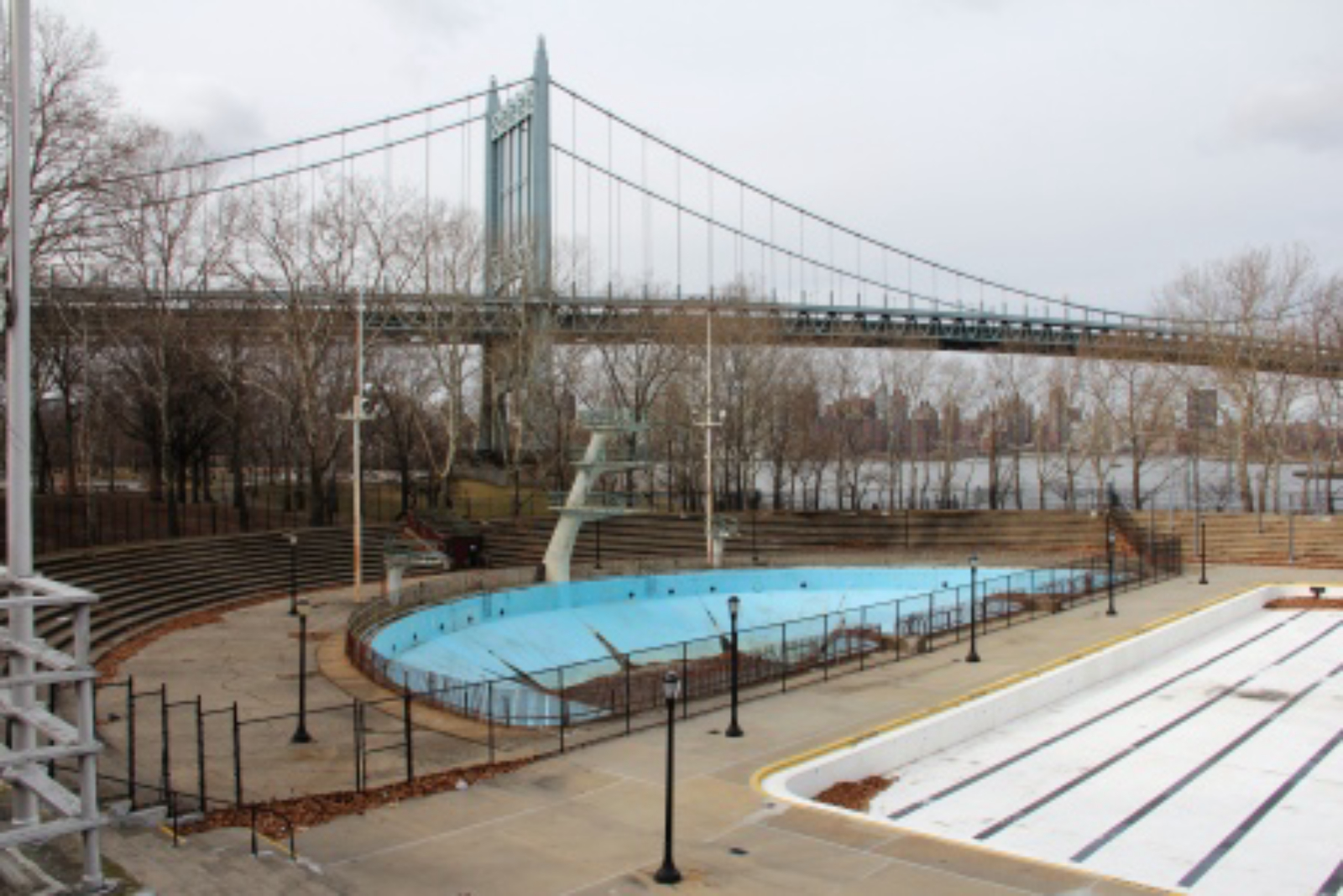
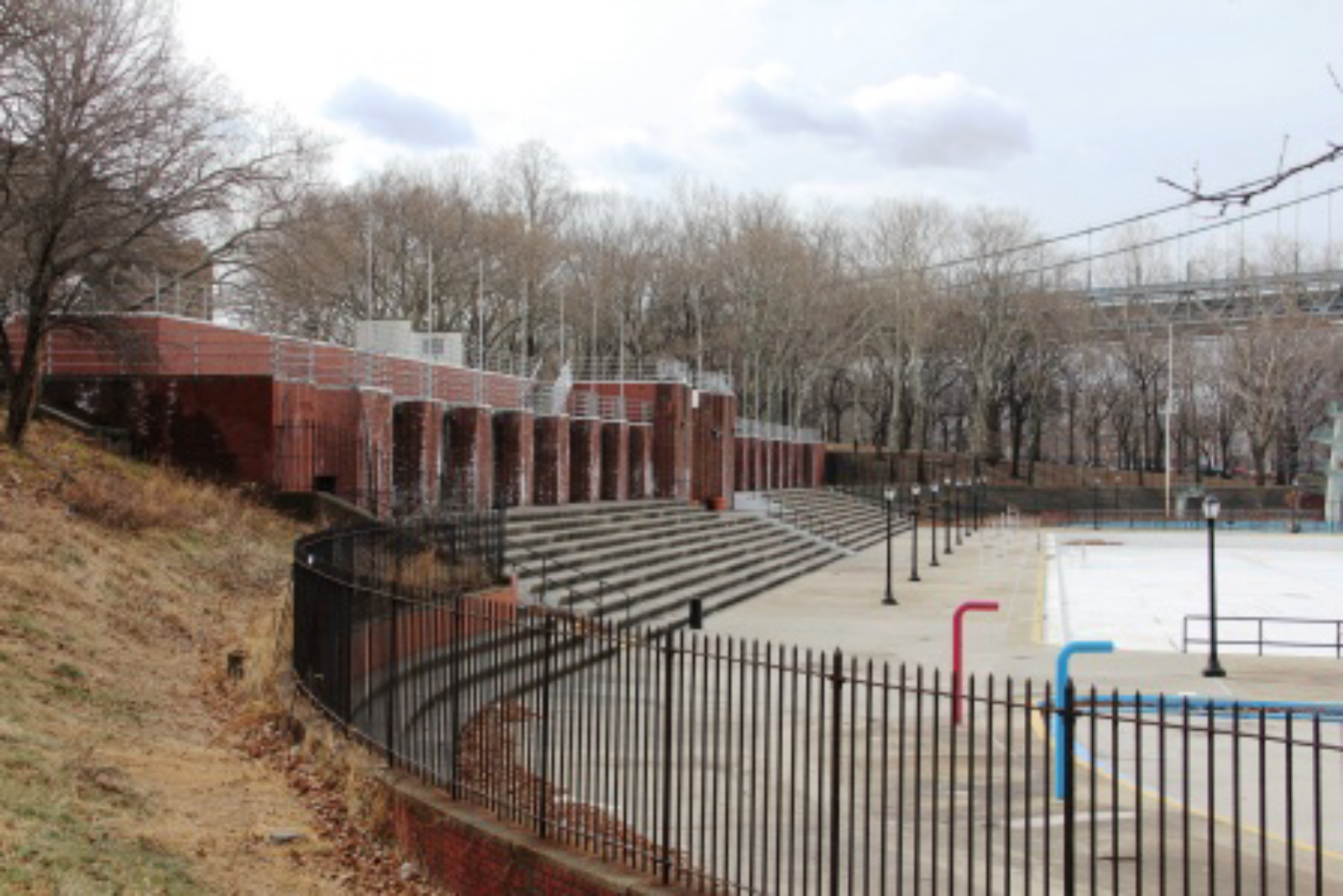
In plan, the complex is comprised of three pools: the main pool that can be divided into three Olympic sized pools, and this section is flanked on either side by a semicircular wading pool to the north and a semicircular diving pool to the south. The complex is also terraced on a slope so it rests below the 19th Street level and has a very low profile from Shore Boulevard.
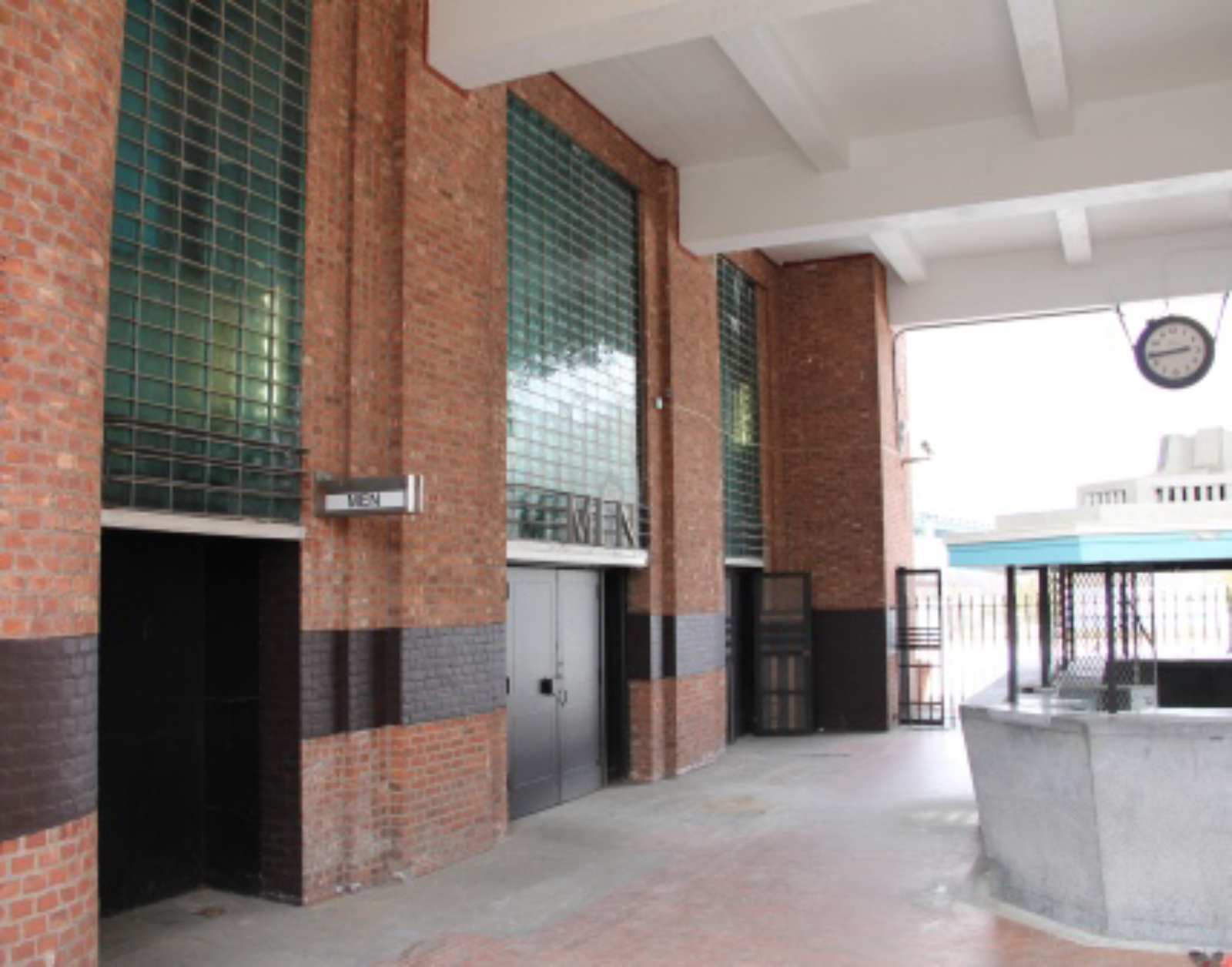
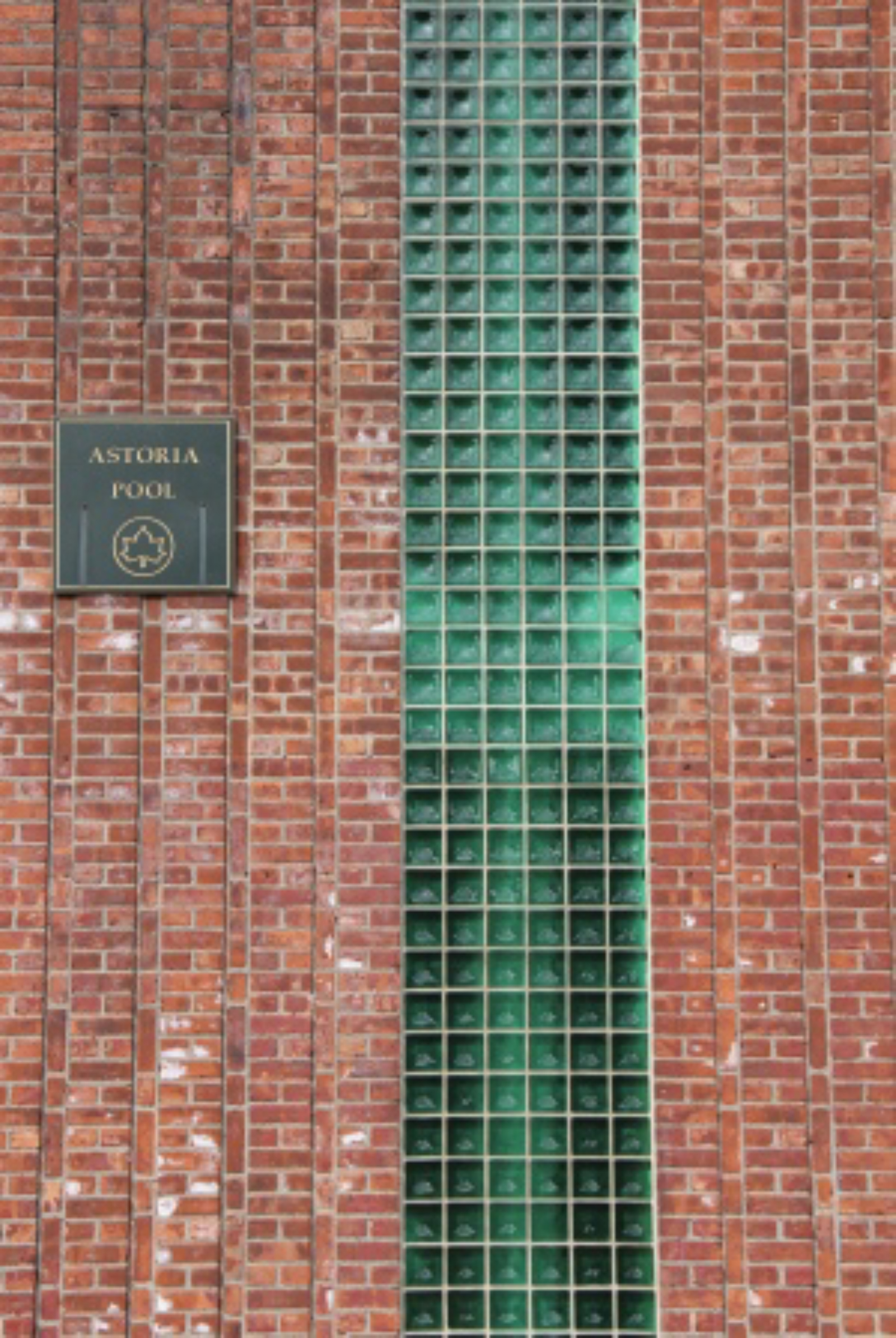
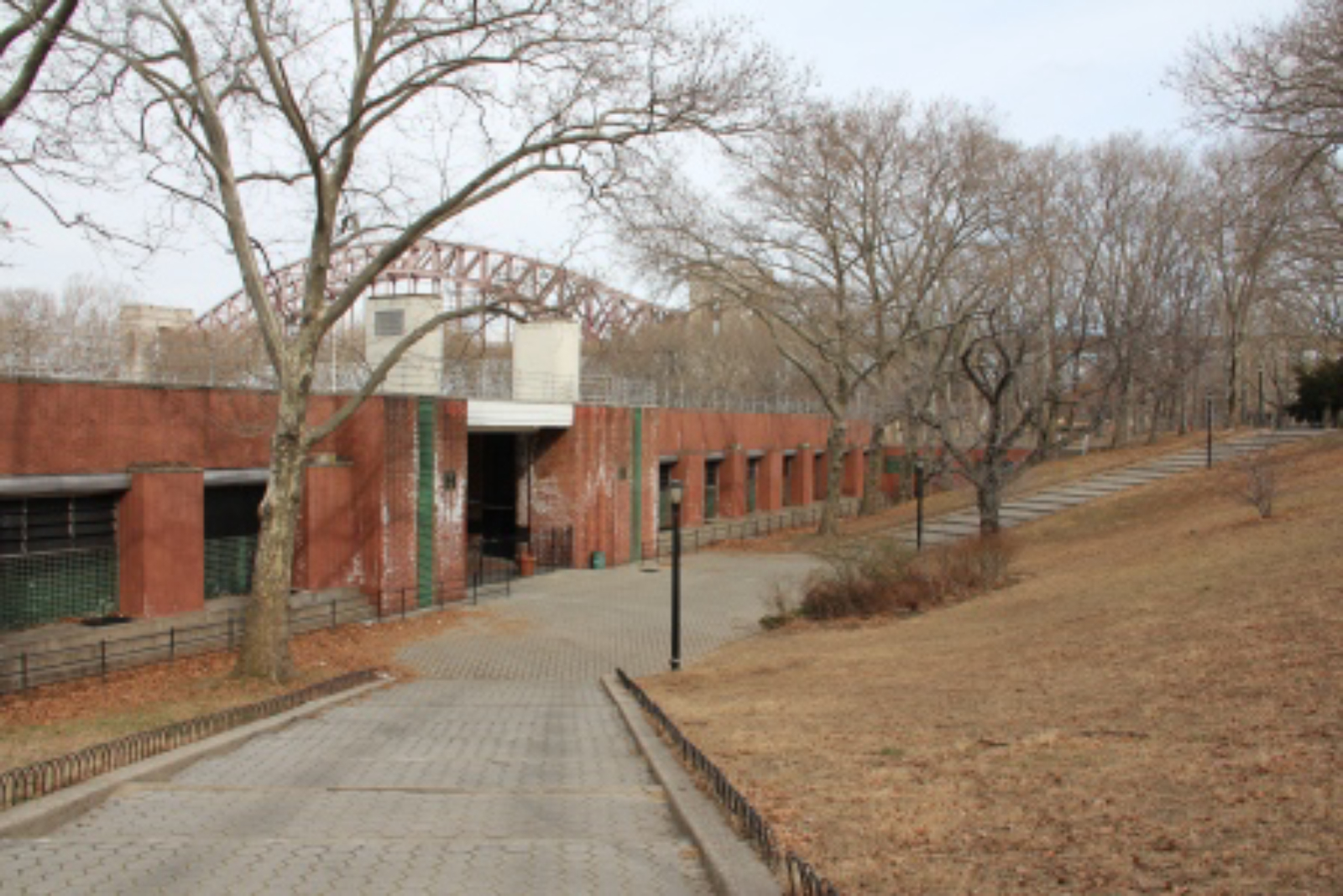
The main structure is built out of red brick in a Flemish bond with distinctive vertical pilaster-like sections separated by vertical stretchers. Also glass blocks were incorporated into the walls in many areas which would allow light through but provide sufficient privacy to the lockers and changing rooms. Today, most of the bricks and some of the glass blocks have been painted on the exterior facades and in 2011 the glass blocks adjacent to the main entrance were replaced with replicas as part of a restoration project. Wide louvered vents were designed for the east and west elevations of the main building. The main entrance is located along the middle of the eastern elevation and is accessed by a set of diagonal descending stairs from 19th Street. The entry plaza is composed of hexagonal bluestone blocks.
The main building is composed of a central lobby with has a high ceiling and open at both the main and the pool entrances. The main entrance contains a painted wrought iron gate. The lobby contains a covered central ticket kiosk with flanking changing rooms and lockers, each with a gender specific, Deco-style aluminum sign. The lobby floor is paved with brick with a bluestone and granite borders. Above this structure there is a two tiered viewing platform, each edged with Deco-style galvanized metal railings. Each platform is connected by two sets of stairs, as well as a set of stairs at each end leading down to the park. On top of the smaller upper platform above the main entrance are two oval header brick ventilation pylons, which are now painted white.
Inside the complex proper, along the eastern interior wall of the main building, there are nine brick piers oneither side of the main pool entrance. The bond mirrors the exterior with vertical bands of pilaster-like courses divided by borders of vertical stretchers.
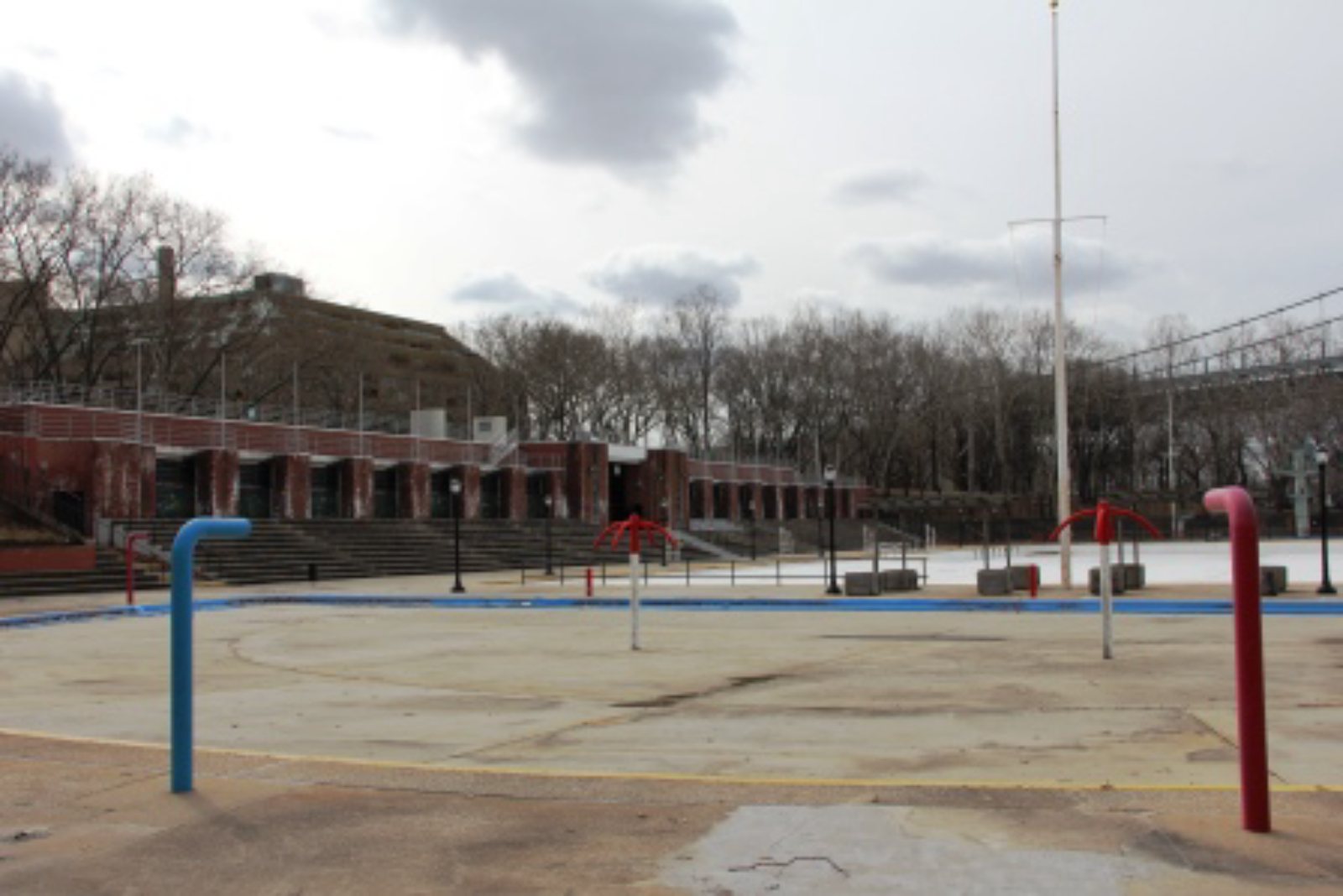
From this level there is a series of stepped solid concrete bleachers descending down to the pool level with stairs located in the center and at each end. The main pool is 330 feet long by 120 feet wide but only four feet deep. There are two semicircular pool located at either end of the main pool, the northern one for wading and the southern one (defunct since 1981) for diving. The wading pool contains two sprinklers while the diving pool contains a tall Deco-style, three-tier and uniquely angled concrete diving platform. Surrounding the diving pool, the concrete bleachers continue from the main pool, while the bleachers surrounding the end of the wading pool are smaller as they contain far fewer steps.
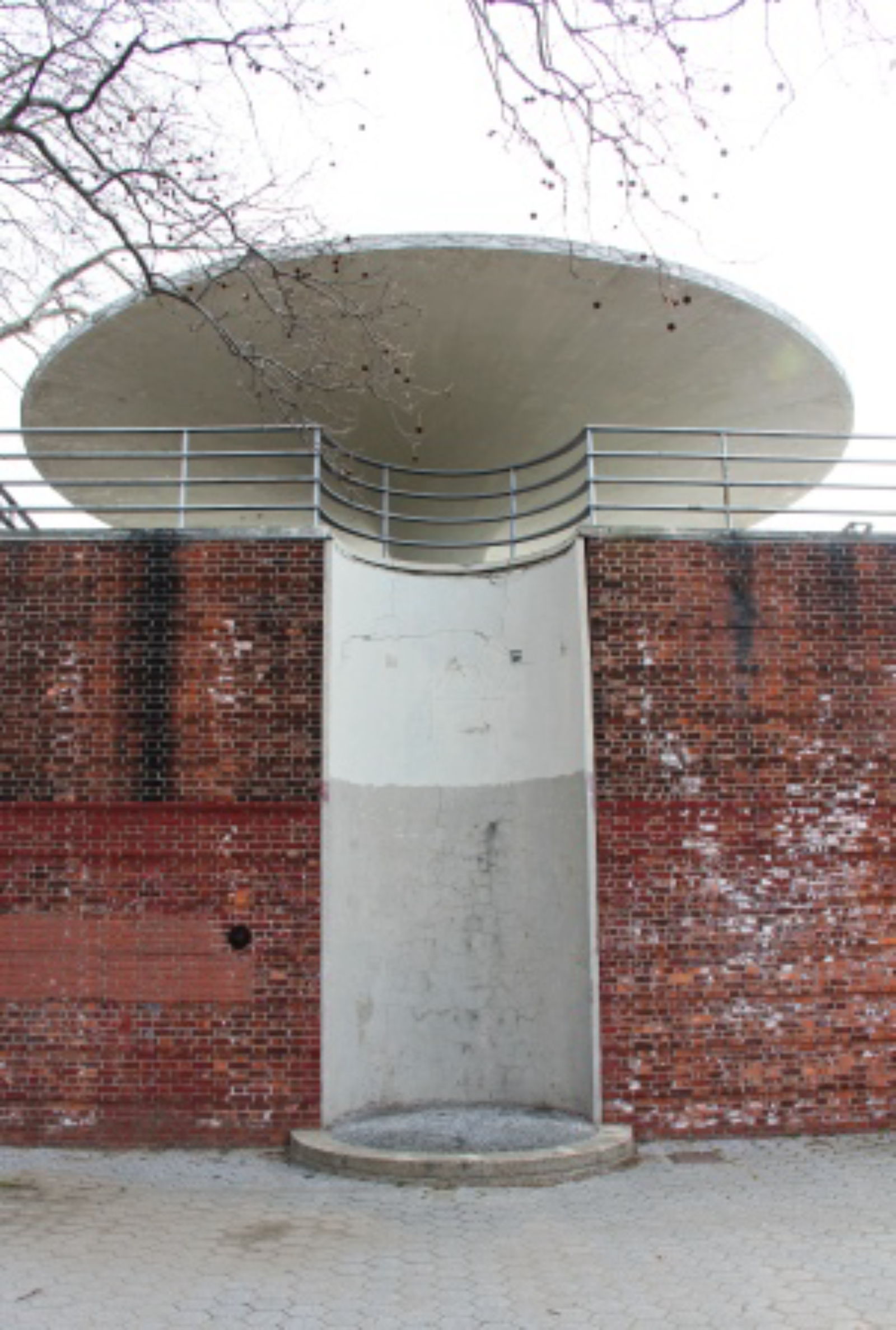
The western edge of the pool deck contains three structures that extend out towards the river. Flanking a central snack shop are two filter houses, whose roofs function as viewing platforms accessed by side stairs. These contain distinctive cantilevered concrete, saucer-shaped roofs to provide shade. All these buildings are constructed of similar Flemish bond brick and the pool side elevations are all painted blue or have non-original murals. Along the outer western elevation there are nine brick piers and the whole pool area is surrounded by cast iron railings.
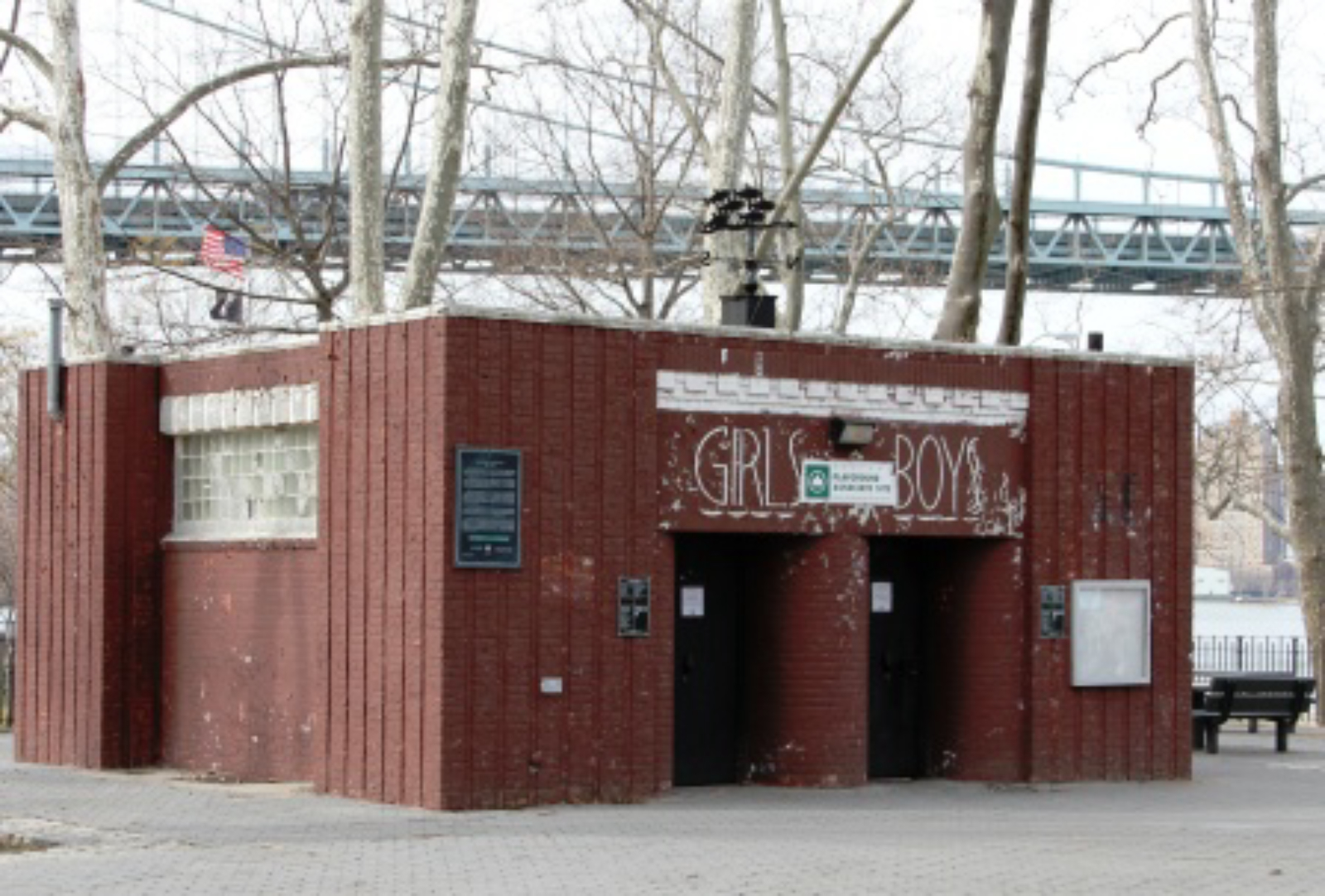
To the west of the pool complex is an attached playground and comfort station of a similar brick design.
December 1934-June 1936
The only change in the physical context, apart from the noted renovations to the complex, was that the landscaping in Astoria Park has matured significantly in the past 75 years so that the open vistas once enjoyed are restricted to the north and south by large trees. The complex is expertly positioned within Astoria Park with commanding views of the East River, the RFK Triborough and Hell Gate bridges. Built on a slope, the buildings have a very low profile and can fade away within the park’s arboreal setting.
The design of the building itself, constructed of modest red brick, bluestone trim, glass block and concrete, creates an intricate texture of a Streamlined Moderne design. The use of inexpensive materials was a requirement of the Works Progress Administration.
The Astoria Park Pool and Play Center was considered the pinnacle of LaGuardia’s and Moses’ public pools and exemplified New York’s WPA construction projects. Prior to Moses, there were few public pools in the New York City, and many city residents escaped the summer heat by swimming in the rivers, which was both dangerous and unsanitary. Public pools grew in popularity across America in the 1920s and 1930s, following a increasing awareness for the benefits of excercise and recreation. Indeed the National Recreation Association was formed in 1930 following two national conferences hosted by President Coolidge in 1924 and President Hoover in 1929.
The city followed the construction of these pools with an extensive campaign that would teach the city's children and adult how to swim. Swimming pools allowed a new era of informality, where people irrespective of gender, age and even ethnicity could mix. Robert Caro has cited the Thomas Jefferson Park Pool in East Harlem as an example of Moses' racist attitude to African Amercian residents as he was purported to have turned off the heating to dissuade them from using the pool. However Marta Gutman has countered that any segregation in the pool was likely down to pre-existing racial tensions between African American and Italian residents of Harlem. She also noted that there was integration between Jewish and African American residents at Betsy Head Park Pool, while the WPA built St. Louis Fairgrounds Park Pool had enforced segregation until 1949.
In 1937 the Astoria Pool and John Matthews Hatton won the Pittsburg Glass Company Award for Public Buildings. The pool hosted both the 1936 and 1964 US Olympic Swimming Trials. It was also the proposed site for the Aquatic Center in the 2012 New York Olympic bid, which ironically would have destroyed the original complex. After losing out to the London in 2005, the complex was finally landmarked in 2006, after a previous 1990 bid failed. Indeed it was the first of the WPA era pools to be landmarked by the City.
The place of Astoria Park Pool within New York City’s history is undeniable. The Astoria Park Pool is part of the portfolio from ‘the Good Robert Moses” before the post war issues with urban renewal and interborough highways forever tainted his legacy. In addition, the complex was an award winning architectural structure and the recent conservation work conducted by Department of Parks and Recreation has shown a glimpse of the original splendor of the complex. Finally and perhaps most importantly, the Astoria Park Pool and Play Center was part of an immensely successful WPA project that created an enduring recreational resource for the Astoria community and the City for over 75 years.
The Astoria Park Pool and Play Center is worthy of being added to the Docomomo Register for architectural, cultural, historical and social reasons. Furthermore, despite being landmarked in 2006, there is a 2011 proposal to convert the defunct diving pool into a public amphitheater for musical performances. Rogers Marvel Architects were commissioned to review the current conditions and create a Master Plan for the pool.
Primary Sources
Moses, Robert, ‘Municipal Recreation’ in American Architect and Architecture (November 1936, p. 21-34)
Moses, Robert, Public Works: A Dangerous Trade, New York, McGraw-Hill, 1970: 25
’23 Bathing Pools Planned by Moses’, New York Times, July 23, 1934
‘Park Work Begun on 2 Bathing Pools’, New York Times, October 4, 1934, 48
‘Work Relief Booms Parks’, New York Times, September 22, 1935, E10
‘Mayor Occupies Summer City Hall’, New York Times, July 3, 1936, 1
Pool: Crotona Park, New York City park department. 1936. Architectural Forum. 65:369.
Astoria swimming pool pavillion, New York: J.M. Hatton, archt. 1937. Architectural Forum. 67:127-128.
Latham, W. H., “Swimming Pool Construction”, American Architect and Architecture (November 1937: 33-34)
‘City Parks Show Gain in Public Use’, New York Times, Sept 27, 1937, 23
‘$52,410,007 Spent by WPA in Queens’, New York Times, Sept 27, 1937
“Recreational Structures”, Architectural Record 89.4 (1941): 93
Secondary Sources
Caro, Robert A., The Power Broker, Robert Moses and the Fall of New York, Vintage Books, 1975
Colangelo, Lisa, ‘Defunct diving pool at Astoria Park to be turned into a performance space’, New York Daily News, December 6, 2011,
Cranz, Galen, 1982 The politics of park design : a history of urban parks in America (Cambridge, Mass., MIT Press) [AA9060 C852]
Cutler, Phoebe, The Public Landscape of the New Deal, Yale University Press, 1985
Day, Louis J. and Stedman, C. W., An Elementary Treatise on the Construction, Sanitation and Operation of Swimming Pools, Josam Manufacturing Company: Cleveland, 1937)
Gebhard, David, “The Moderne in the U.S. 1920-1941” Architectural Association Quarterly 2.3 (1970): 7-24
Gutman, Marta, 2008a, ‘Equipping the Public Realm’ in (eds.) Hillary Ballon and Kenneth T. Jackson, Robert Moses and the Modern City: The Transformation of New York (W. W. Norton & Company: New York)
Gutman, Marta, 2008b, ‘Race, Place, and Play: Robert Moses and the WPA Swimming Pools in New York City’ in Journal of the Society of Architectural Historians , Vol. 67, No. 4 (December 2008), pp. 532-561
Miller, Linda G. 2004. Taking back the shore: a sampling of projects that are reclaiming for public use miles of New York Harbor and its rivers' shoreline. Oculus. 66 (2):40-44[AB Oc9]
Presa, Donald G., Astoria Park Pool and Play Center, Landmarks Preservation Commission (June 20, 2006, Designation List 377, LP-2196)
Price, Marshall “Swimming in Modernism: The Astoria Pool Complex”, (CUNY, unpublished manuscript, 2002)
Rosen, Daniel Edward, ‘Master plans drawn up to refurbish Historic Astoria Park Pool into year-round facility’, New York Daily News, June 21, 2010
Stern, Robert A. M., 1987, New York 1930: Architecture and Urbanism between the Two World Wars, Rizzoli: New York, p.707-725
‘Great Place to Be When the Mercury Hits 88’, New York Times, August 11, 1975
‘Swimming in the City’, New York Times, July 2, 1976
Daniel Edward Rosen, “Master plans drawn up to refurbish Historic Astoria Park Pool into year-round facility”, New York Daily News, June 21, 2010
Sarah Maslin Nir, “Diving Board Is Set to Begin a Second Career in the Theater”, New York Times, March 5, 2012