Washington Dulles International Airport Main Terminal

In the middle of the twentieth century, plans for Washington Dulles International Airport grew out of the need for another airport in the Washington D.C. region as the Washington National Airport (Ronald Reagan Washington National Airport) was already outgrowing demand. The second Washington Airport Act of 1950 was passed by Congress to provide for the construction of a new airport. A site was chosen 26 miles from Washington D.C., and the construction of Dulles Airport began on September 2, 1958.
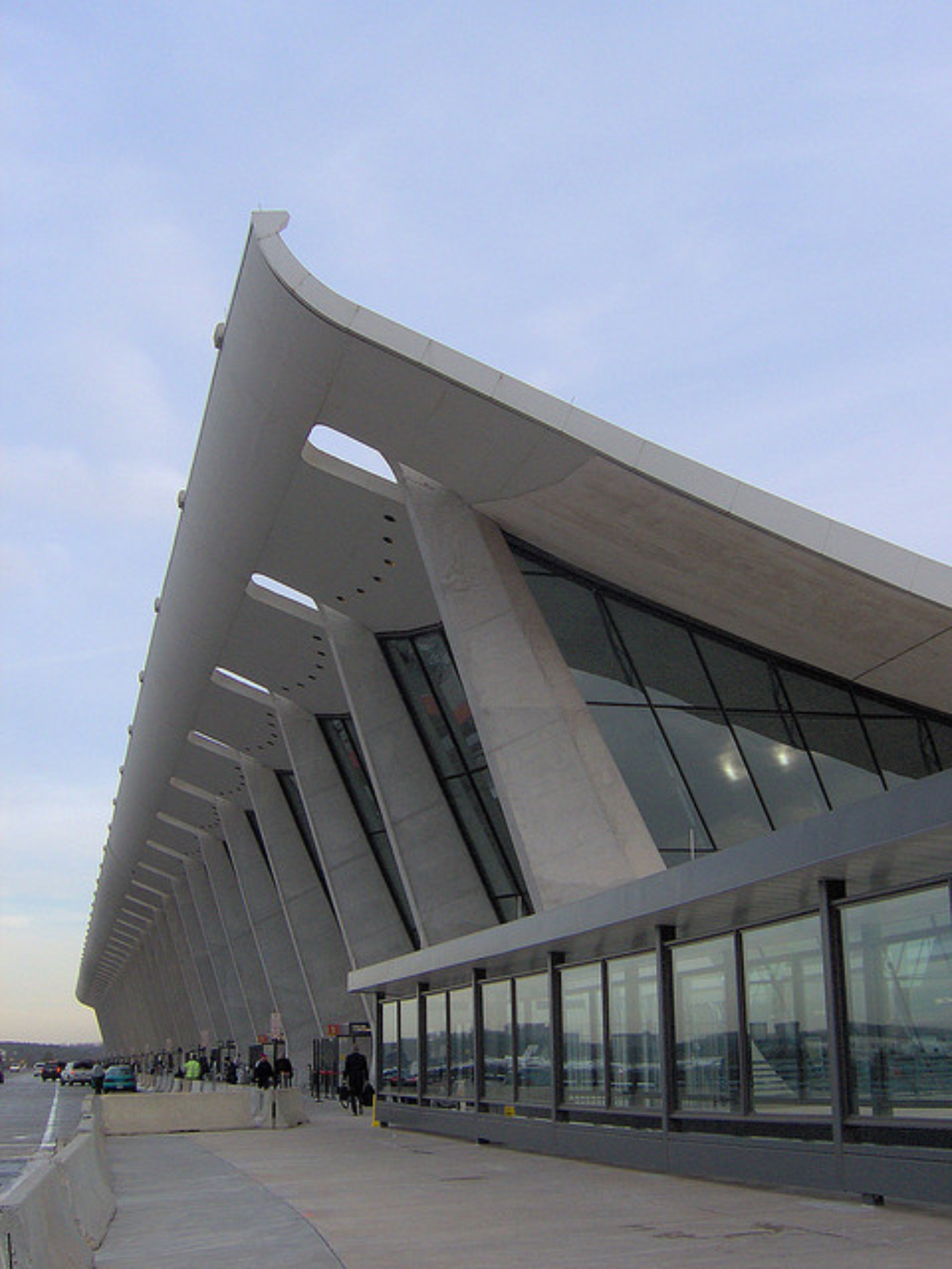
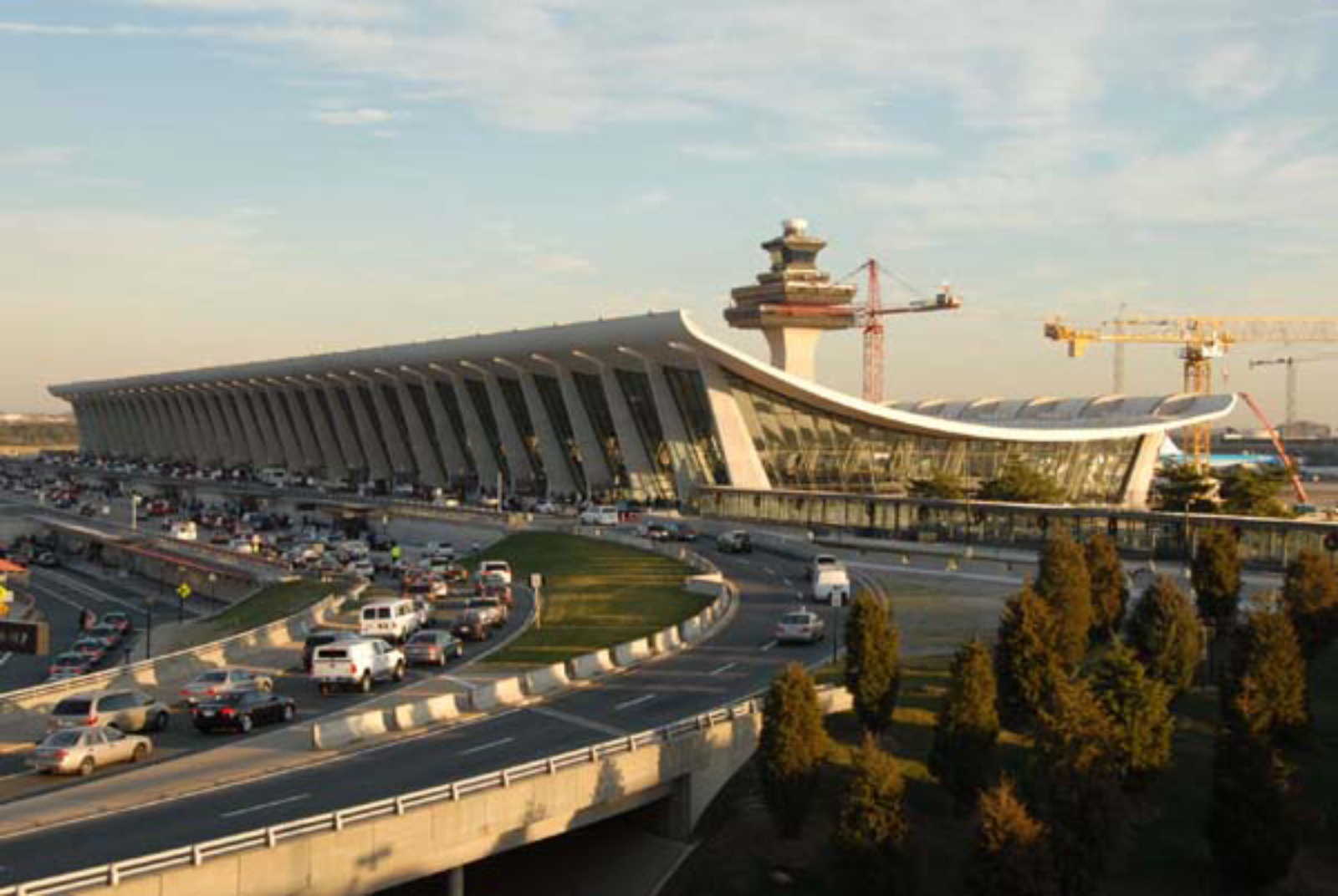
The Main Terminal and airport complex sits on 11,803 acres in Dulles, Virginia, and the Main Terminal and complex use approximately 5,000 acres. The Main Terminal is reached by an access road leading to a three-leveled oval roadway that runs parallel to the north elevation. The 1,240’ long building is composed of concrete columns 40’ apart along the north and south elevations supporting an upward curving concrete panel roof held together by catenary cables. The columns punctuate the roof and curve over the top of the structure on the north and south elevations. The spaces between column and roof are filled with glass panels curved into the building. The form of the building was designed by Saarinen to be centered between earth and sky, and as Saarinen stated to “both rise from the plan and hover over it.” The interior space of the main level is one large, open area designed by Saarinen to expedite flow of passengers from the roadway to the waiting planes and to connect the interior of the terminal to the exterior. The ground floor contains baggage circulation, and an additional basement also serves this function. A concrete control tower is situated south of the Main Terminal. Additional later concourses were added to the complex and run parallel to the Main Terminal along the south elevation and are linked to the Main Terminal by mobile lounges and an underground walkway.
The building was constructed with reinforced concrete columns 40’ apart supporting an upward curving concrete panel roof of approximately 1792 precast concrete panels held together by catenary cables, which allowed for the uninterrupted interior space. Glass panels framed by metal surrounds create large open areas between the columns that slightly curve in towards the interior.
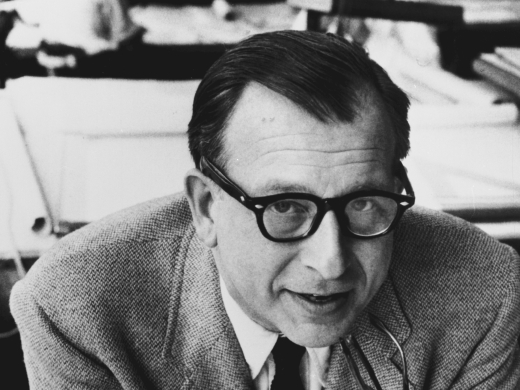
When the need for Dulles Airport arose in the mid twentieth century, the entire functionality of how an airport works and operates was studied by Eero Saarinen to design an efficient new airport specifically geared for jet airplanes. Saarinen focused on this aspect of the structure when planning the flow of passengers from the drop off outside of the Main Terminal, through the building, and onto the waiting airplanes. A significant feature of Saarinen’s design was the mobile lounge concept. The mobile lounges allowed for the Main Terminal to be a single independent mass without what Saarinen called extending structural “fingers.” The mobile lounges were a modernistic design to bring passengers directly to the plane and to shorten the walking distance. Saarinen also planned for the growth of the Main Terminal and the airport complex and incorporated future extensions into his design in order to keep pace with the expanding airport industry. The Main Terminal was a modern building signifying modern travel by the jet airplane.
When planning and designing Washington Dulles International Airport, Eero Saarinen tested the functionality of other airport buildings and incorporated his findings into the design of the terminal. Teams were sent out to record information about existing airports such as walking distance, interchange problems, schedules, weather, and baggage handling to incorporate all aspects of air travel into his design. The design of the roof, with concrete panels supported by catenary cables, stands out as an important technical feature of the building and allows for an uninterrupted interior space to streamline the flow of passengers from the unloading area up to the mobile lounges and onto the plane. Saarinen was also taking into consideration the jet planes in his design, with the mobile lounge concept reducing reduced airport noise near the terminal.
Eero Saarinen’s design of Dulles Airport was centered on how architecture could facilitate the travel experience of the passenger in the new age of jet travel. His modernistic creation reflected the connection of ground to sky, and Saarinen was also attempting to express “the movement and excitement of modern travel by air.” Saarinen was making a statement against static Federal architecture by incorporating the concept of movement into his design. Saarinen also extended the role of the architect by not only creating a functional and stylistic design for the Main Terminal but by providing a master plan which would take into consideration future expansion of the entire complex.
The architectural design of the Main Terminal subtly reflects flight and movement. The airport has been touted as a landmark of modern architecture due to its simplistic means of fulfilling the complex needs of an airport. Saarinen took an intricate problem and made it simple, and his design for the Main Terminal stands out as a prominent building in the Modern Movement.
In 1958 Eero Saarninen and Associates were chosen as the architects for a new airport to be built twenty six miles west of Washington D.C. Construction began that year, and Dulles International officially opened and was formally dedicated by President John F. Kennedy on November 17, 1962. Dulles Airport received praise after its completion for its architecture and design, and in 1966 the Dulles International Airport Terminal Building received the Honor Award from the American Institute of Architects for its “vigorous, free and graceful movement which we associate with flight, while avoiding literal and obvious analogy.” In 1978 the airport was determined eligible for the National Register of Historic Places before it reached fifty years of age because of its architectural importance. It has been heavily praised from the beginning as a monument to modern travel. Major additions to the airport began in the 1980s with the addition of a 50’ wide skylighted corridor added to the south elevation of the Main Terminal. In 1984, when the airport was renamed Washington Dulles International Airport, three proposals were considered to address airport efficiency problems. In 1985 two temporary structures, Concourses C and D were constructed away from the Main Terminal which expanded the complex. An International Arrivals building was completed in 1991 300’ from the terminal, but by 1996, the International Arrivals building became part of the Main Terminal when SOM’s expansion was completed and effectively joined the two buildings. Concourses A and B were added in 1999 further expanding the entire airport complex. D2, a Dulles Development Program, was approved in 2000 to improve the efficiency and growth of the airport, which included a renovation of the interior of the Main Terminal in 2005 to maximize public space within and to update the technologies of the building.

“A.I.A Selects Annual Honor Awards.” Architectural Record, July 1966, 41.
“Airport Development Planning.” Progressive Architecture, November 1961, 158-163.
“Dulles Airport.” Progressive Architecture, August 1963, 86-101.
“Dulles Airport Expansion.” Architecture, November 1993, 40-41.
“Dulles International Airport.” Architectural Record, July 1963, 101-110.
Freeman, Allen. “SOM’s Addition to Dulles International Airport Respects Eero Saarinen’s 'Modern Masterpiece.'” Architectural Record, March 1997, 62-67.
“Hammock Type Roof for Dulles Airport.” Architectural Record, November 1961, 198.
“History of Washington Dulles International Airport.” Metropolitan Washington Airports Authority. http://www.metwashairports.com/dulles/
Lebovich, William. “Redoing Dulles: Three Proposals.” Progressive Architecture, April 1984, 29-30.
“A New Airport for Jets.” Architectural Record, March 1960, 175-182.