United Nations General Assembly Building

The United Nations General Assembly building was constructed as part of a larger complex, intended to be the Headquarters for the United Nations. The General Assembly building was built for the United Nations delegation, comprised of representatives from Member States of the United Nations, who come together annually for sessions of the General Assembly. There are three other buildings on the 18-acre complex in addition to the General Assembly building, including the Secretariat building, Conference Area, and Library, as well as landscaped plazas.
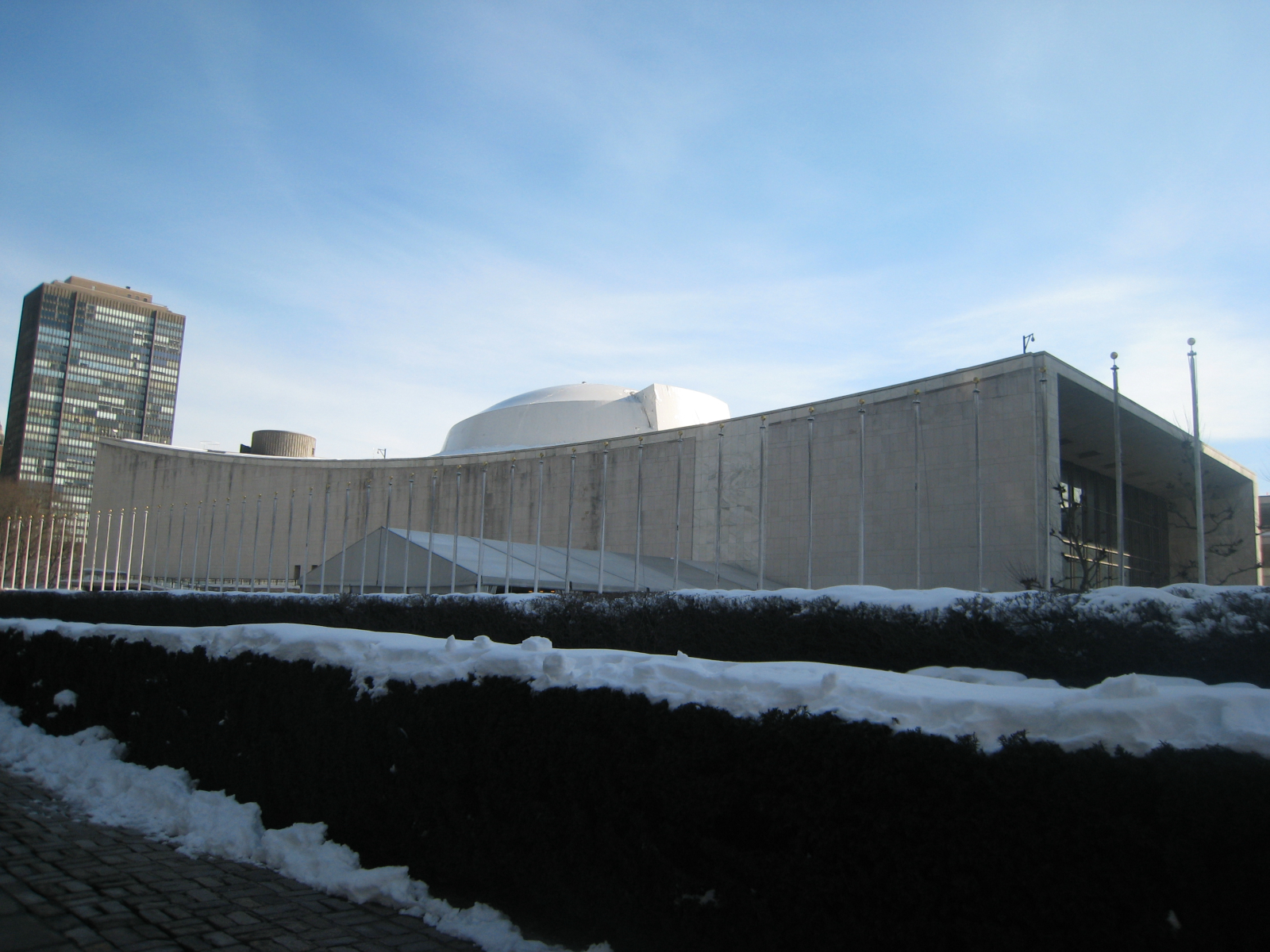
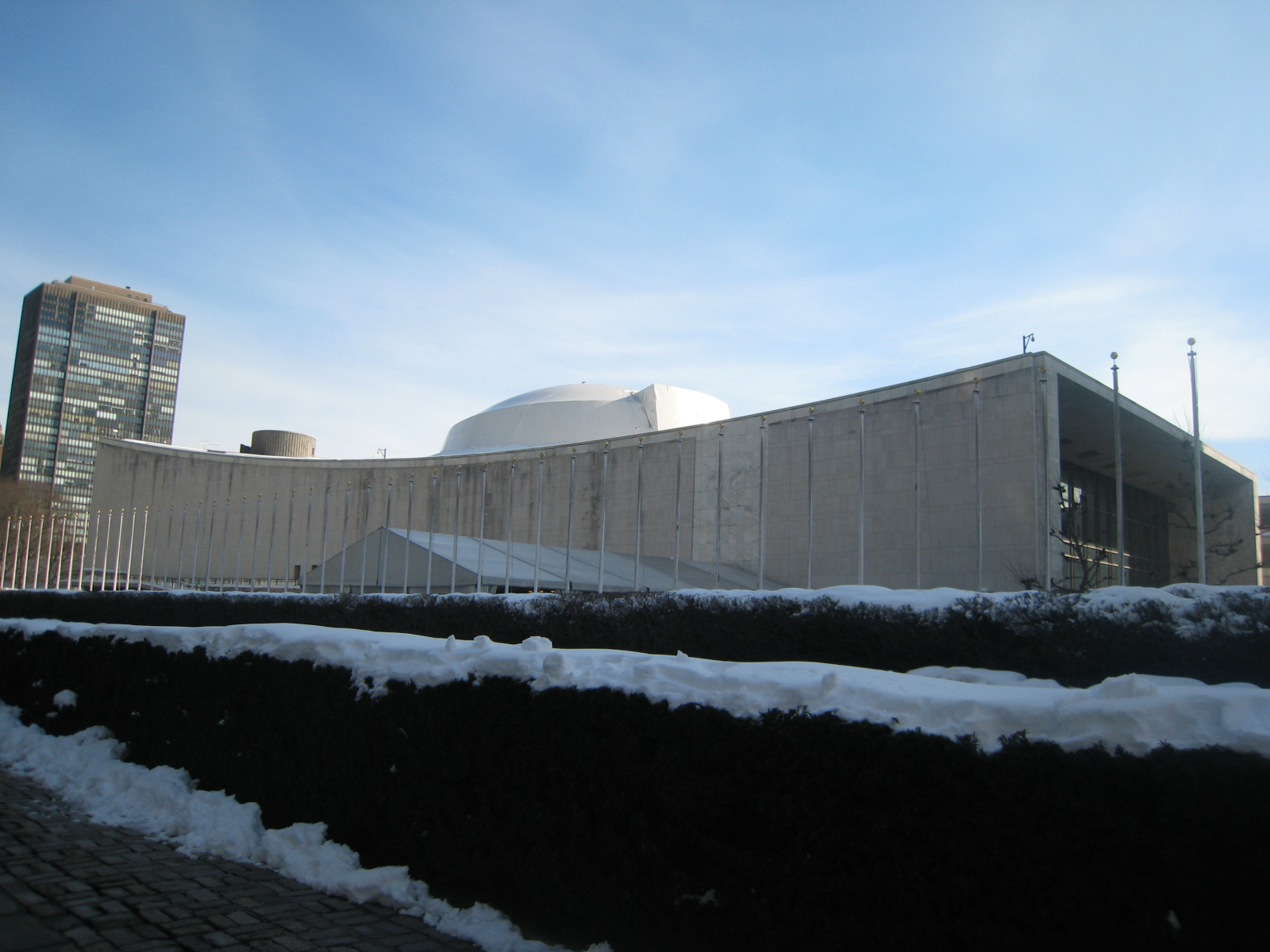
The five story General Assembly building is the northernmost structure on the United Nations Plaza in New York City, located between 1st Avenue and East River Drive, and spanning from 44th Street to 45th Street, approximately. Its footprint is a curved trapezoid, with its 380 foot long west and east facades concavely curving. These two facades have minimal ornament and are comprised of English limestone with Vermont marble panels and trimmings to correspond with the north and south facades of the Secretariat building to the southeast. The north and south facades are straight; the wider north facade has marble piers holding translucent glass panels while the south facade is comprised of a recessed marble frame holding a 53.5 foot high plate-glass window. The north facade, which opens into a massive landscaped plaza, is the main entrance to the Headquarters for the public, while the south facade, which opens into the Secretariat plaza, is the main entrance for the United Nations delegates. There is a shallow copper dome on the top center of the structure. Inside beneath the dome is the main Assembly Hall, comprising the second, third, and fourth floors of the structure at 165 feet in length, 155 feet in width, and 75 feet in height. This hall is used for the annual General Assembly meetings and has been expanded to reflect the increased membership of the United Nations. The lower levels contain conference rooms as well as the communications hub for the entire complex.
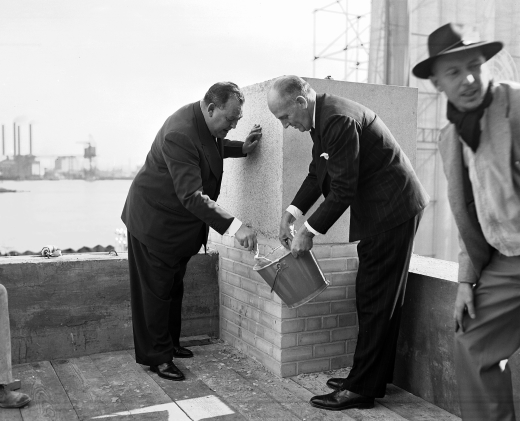
1949-1950(a)
The context of the General Assembly building within United Nations Headquarters is almost the same today as it was in 1950. The only major addition, the Dag Hammarskjold Library to the south of the General Assembly building, was constructed in 1961.
The General Assembly building is an example of the modernization of building technology after World War II. The structure has a steel frame with English limestone flanking the east and west facades. The north facade is comprised of translucent glass panels, designed specifically for the building, set into marble piers, corresponding with the 53.5 foot high plate glass window of the south facade, also set within a marble frame. These cantilevered entrances illustrate the technological advances in engineering at the time. The sloping roof and shallow copper dome on top of the steel structure demonstrate the dismissal of classical proportions in modernist architecture and construction.
The design and construction of the General Assembly building and the entire United Nations complex remains a monument to the international organization in the post-World War II era. At the time of construction, these structures provided a symbol of the unification of the world with the intention of maintaining peace. In addition to the multi-national design team that created the General Assembly building, its worldly materials, such as English limestone and Vermont marble used on the exterior, demonstrate the international spirit of the time.

The General Assembly building is an example of the International Style of modern architecture, with its open interiors, minimal ornamentation, and regularity, as well as an extensive use of glass. Its design illustrates an international effort, combining the modern architectural styles of the numerous regions represented by its Board of Design Consultants, creating a unique structure that did not represent a single nation's style, but rather the architectural style of the unified world after World War II.
The design and construction of the General Assembly building in conjunction with the rest of the United Nations complex demonstrates the significance of the organization in the post-World War II era. The decision to build the complex in the modernist style illustrated the stability and prominence of the organization in a world shattered by war. Moreover, constructing this complex in New York City revealed the power and preeminence of the city at this time.
The General Assembly building represents a significant point in both modernist architecture and the post-World War II era. It is a prominent example of the collaboration of a multi-national design team aiming to create a culturally, socially, politically, and architecturally significant group of structures illustrating the desire for a unified and peaceful world. The need to expand the General Assembly hall and conference rooms over the last 60 years reveals the success of the United Nations organization, symbolized by the General Assembly building and corresponding structures on the United Nations Plaza.
"Fact Sheet: United Nations Headquarters." Visitors Services, United Nations Headquarters. 1 February 2011. ~ Hughes, C.J. "UN Headquarters Gets $1.8 Billion Facelift." Architectural Record, 20 September 2010. 1 February 2011. ~ "International Style." Encyclopedia Britannica Online, 2011. 1 February 2011. ~ Longmead, Donald. "Icons of American Architecture, Volume 2." Connecticut: Greenwood Press, 2009. Pages 407-415. ~ Pastore, Arthur R. Jr. "UN's Modernistic Headquarters." The Christian Science Monitor, 27 September 1952. Page 17. ~ "The Story of United Nations Headquarters." Public Inquiries Unit, United Nations. Fact Sheet No. 23, July 2006. 30 January 2011. ~ "United Nations Capital Master Plan: Frequently Asked Questions." United Nations, 2006. 1 February 2011. ~ "United Nations Plaza, New York, NY." Google Maps, 2011. 31 January 2011.