Quarry Visitor Center at Dinosaur National Monument

In 1944, the National Park Service (NPS) initially conceived of a museum and visitor center building that would incorporate and protect the Douglass Quarry at Dinosaur National Monument (DNM). The richest deposit of Jurassic dinosaur bones ever discovered, the Douglass Quarry was first discovered in 1909 and had been excavated by a team from Pittsburgh’s Carnegie Museum, yet it remained unprotected from the elements and potential looting. Due to wartime funding shortages, the museum project was temporarily abandoned, though the NPS did manage to erect an interim shelter in 1951. Then, in 1956, as part of the “Mission 66” plan for the development of park infrastructure, the NPS decided to construct a monumental modernist building to house the visitors center and protect the Douglass Quarry. Through this iconic building, the NPS hoped to demonstrate its commitment to the protection of DNM, which had recently been threatened by the proposal of the Echo Park Dam construction project.
That same year, the NPS selected the San Francisco-based firm of Anshen+Allen to design the new building. Like the Chapel of the Holy Cross, a building near Sedona, Arizona that the firm had designed in 1953, the new visitor center was designed to have an intimate relationship with the surrounding landscape. In late 1956, the Mission 66 program allocated $275,000 for the design and construction of the building and Anshen+Allen appointed Richard Hein as project architect. In 1957, the NPS commissioned the R.K. McCullough Construction Company of Salt Lake to build the new visitor center for $309,000.00. On June 1,1958, the NPS officially dedicated and opened the DNM Quarry Visitor Center.
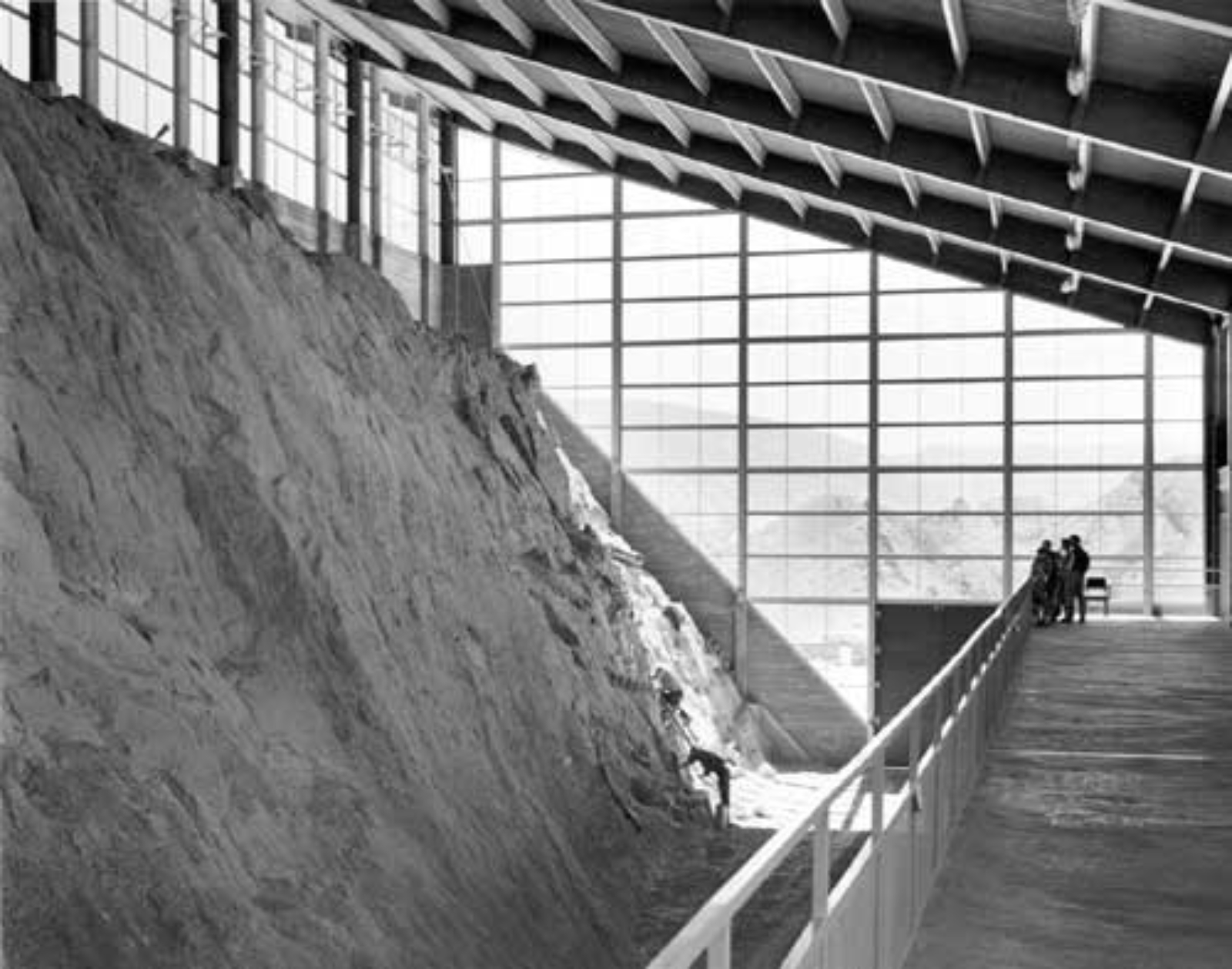
The Quarry Visitor Center at Dinosaur National Monument consists of three main parts: a circular rotunda featuring a lobby and restrooms, a single story administrative and laboratory wing, and the double story display gallery featuring the Douglass Quarry wall, a display of roughly 2,000 dinosaur bones in situ. Each of these parts reflects a different function of the QVC, including welcoming visitors to the park, providing laboratory and administrative space for NPS personnel and sheltering and displaying the Douglass Quarry wall.
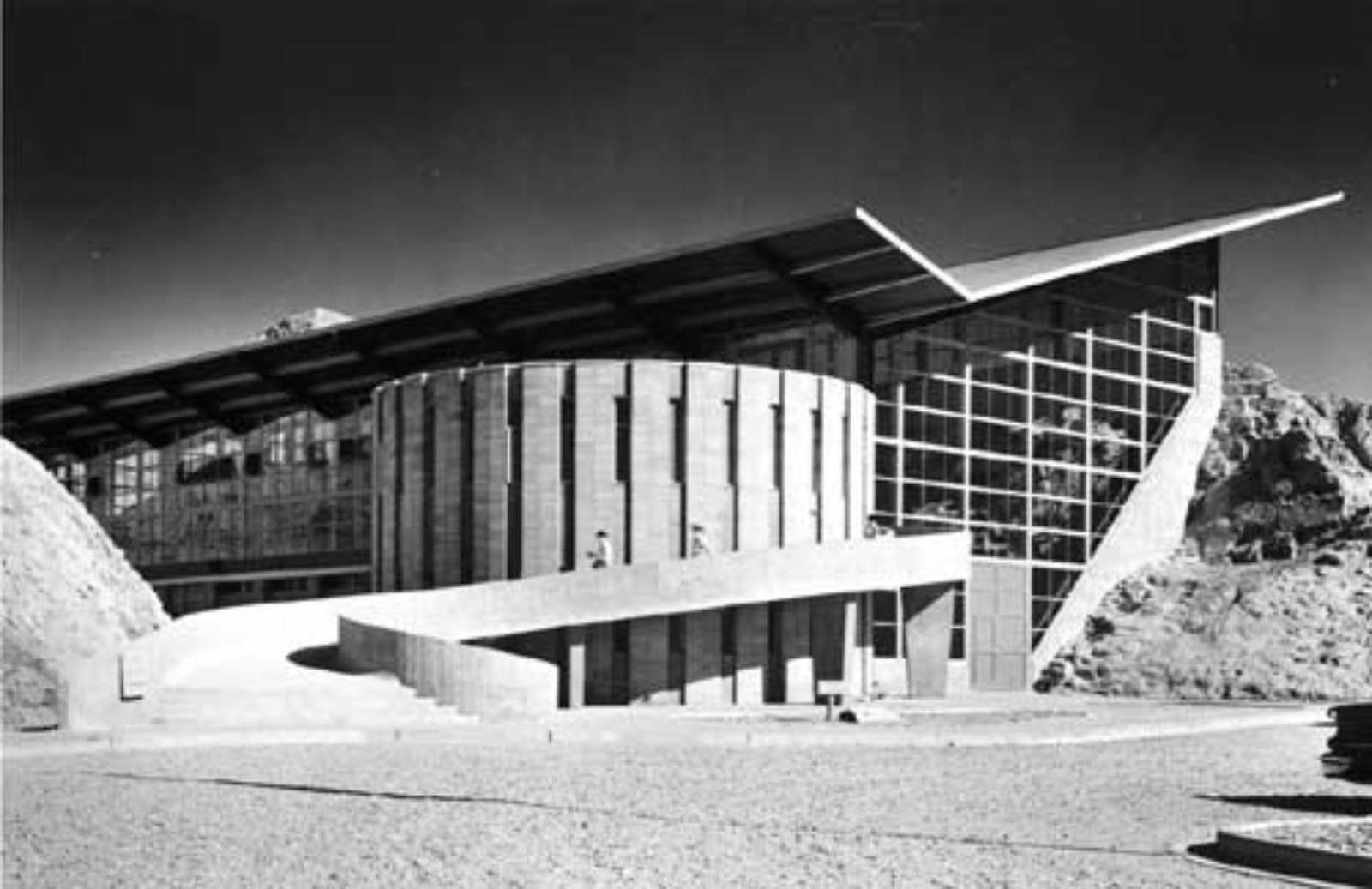
The building itself is located in a draw between two adjacent sandstone ridges, the larger of which actually composes the majority of the north façade. Thus, the building is really a steel superstructure that protrudes above the quarry face and has glass and steel curtain walls draped off of it to better protect the exposed fossils (Fig. 1).
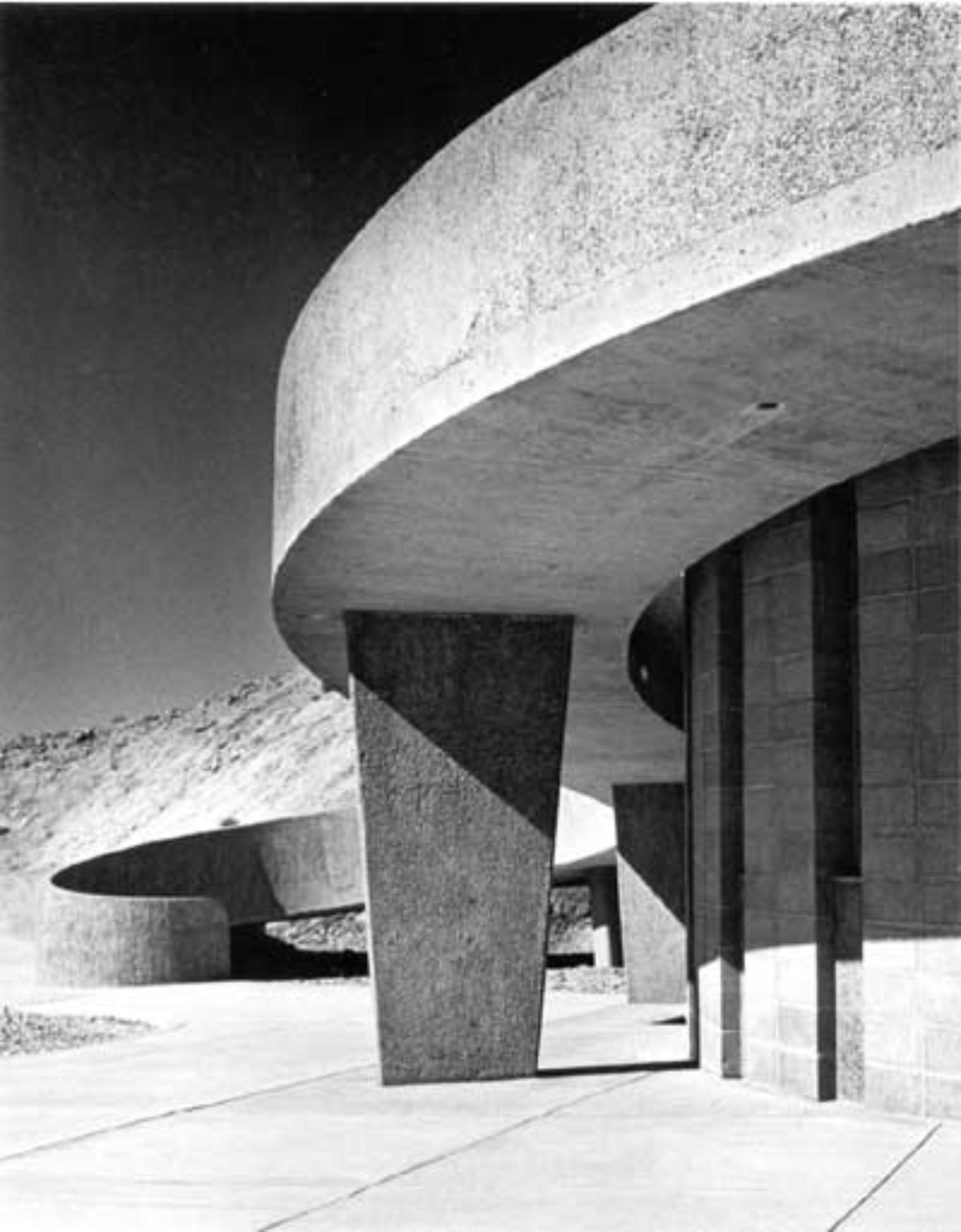
From the parking lot, visitors approached the building via a curved entrance ramp that leads them to the second floor rotunda. Composed of alternating strips of insulated glass, cast-concrete panels, and concrete masonry, the rotunda is topped with a glass skylight above the welcome lobby. Visitors then proceeded to the glass and steel gallery hall, where they could view the Douglass Quarry wall from a vantage point halfway up its face. Signs along the balustrade provided interpretation of the fossils, while the large glass and steel curtain walls that compose the east and west facades allowed natural light to illuminate the fossils in the quarry wall. Visitors would then descend another set of stairs at the end of the gallery and have a chance to closely approach the quarry wall on the first floor. There, they were also able to see into the laboratory space of the NPS paleontologists through reveals located between the main gallery and the administrative wing. The entire construction is supported by a butterfly framework of structural steel (Fig. 2).
Steel butterfly support frame, insulated glass/steel curtain wall, concrete masonry rotunda
The Quarry Visitor Center is located near Jensen, Utah in Dinosaur National Monument. The building itself is situated in a small draw between two sandstone outcrops.
Technical: By 1958, the cast concrete panels and broad curtain-wall facades composed of insulated glass were already well established in the vocabulary of the Modern movement. Perhaps the most challenging technical aspect of the Quarry Visitor Center was successfully incorporating the structure into the landscape, the guiding vision of the Anshen+Allen design. The architects carefully deliberated over the color of the masonry as well as its texture, and all of it was eventually treated with acid to give it a “pebble-like” finish to better mimic the texture of the surrounding stone.
The Quarry Visitor Center was one of the flagship buildings of modern design completed as part of the National Park Service Mission 66 program. Other examples include Neutra and Alexander’s Cyclorama Visitor Center at Gettysburg and Mitchell and Giurgola’s Wright Brothers Memorial Visitor Center. The vision of National Park Service Director Conrad Wirth, Mission 66 was intended to modernize NPS infrastructure and facilities to commemorate its 50th anniversary. This program was a catalyst for introducing modern architecture into the National Park system and reinventing the scope and quality of visitor centers and facilities
The QVC was initially successful in its design, fitting well within the organic modern idiom of Anshen+Allen, protecting the quarry face while providing the public with a first rate facility in which to learn about and appreciate this unique natural resource. The butterfly steel frame mimics the slope of the surrounding sandstone formations and the elaborate curve of the entry ramp evokes the tail of one of the sauropod dinosaurs. Unfortunately, the QVC has been closed due to the ongoing problem of expansive soils underlying its foundation. The building that was designed to protect the quarry wall now prevents visitors from appreciating it.
The Quarry Visitor Center was received favorably in the architectural press, with coverage in Architectural Record as part of a broader article devoted to the work of Anshen+Allen. While neither the QVC nor the firm of Anshen+Allen have been considered to be unusually innovative in the context of the modern movement, this building was an uncommonly successful version of organic modernism made famous by architects such as Frank Lloyd Wright.
A worthy inclusion in the modern movement, the Quarry Visitor Center is currently closed and is likely to be significantly altered to demolished entirely and replaced with a new, LEED certified structure as part of the NPS Centennial Initiative 2016.
Allaback, Sarah. Mission 66 Visitor Centers: The History of a Building Type. Washington D.C., U.S. Department of the Interior: 2000. Accessed through http://www.nps.gov/history/history/online_books/allaback/vc1a.htm. Feb. 25, 2008
Hein, Richard. “Design: Anshen+Allen, San Francisco, California,” AIA Journal. (Dec. 1960)
French, Christine Madrid. “What is Mission 66?” accessed through http://www.mission66.com/mission.html on Mar. 4, 2008.
Sevy, Elaine. “Talking Points on Park Operations” April 7, 2006. Accessed through http://www.peer.org/docs/nps/06_17_4_talkingpoints.pdf. Mar. 4, 2008
Centennial Initiative 2016, celebrating the 100th anniversary of the NPS.
From The Future Of America’s Parks: A Report to the President of the United States by the Secretary of the Interior Dirk Kempthorne. National Park Service. August 2007. Accessed through http://www.nps.gov/dino/parkmgmt/upload/DINO_Centennial_Strategy.pdf. Mar. 1, 2008
“Mission 66: National Park Service History Collection RG 23.” National Park Service. U.S. Department of the Interior. Accessed through http://www.nps.gov/hfc/products/library/mission66.htm. Mar.5, 2008
“Recent Works of Anshen+Allen,” Architectural Record.(Sept. 1958): 165-180
“Why is the Quarry Visitor Center Closed?” National Park Service. U.S. Department of the Interior. Accessed through http://www.nps.gov/dino/why-is-the-quarry-visitor-center-closed.htm. Mar.5, 2008