Phillips Exeter Academy Library

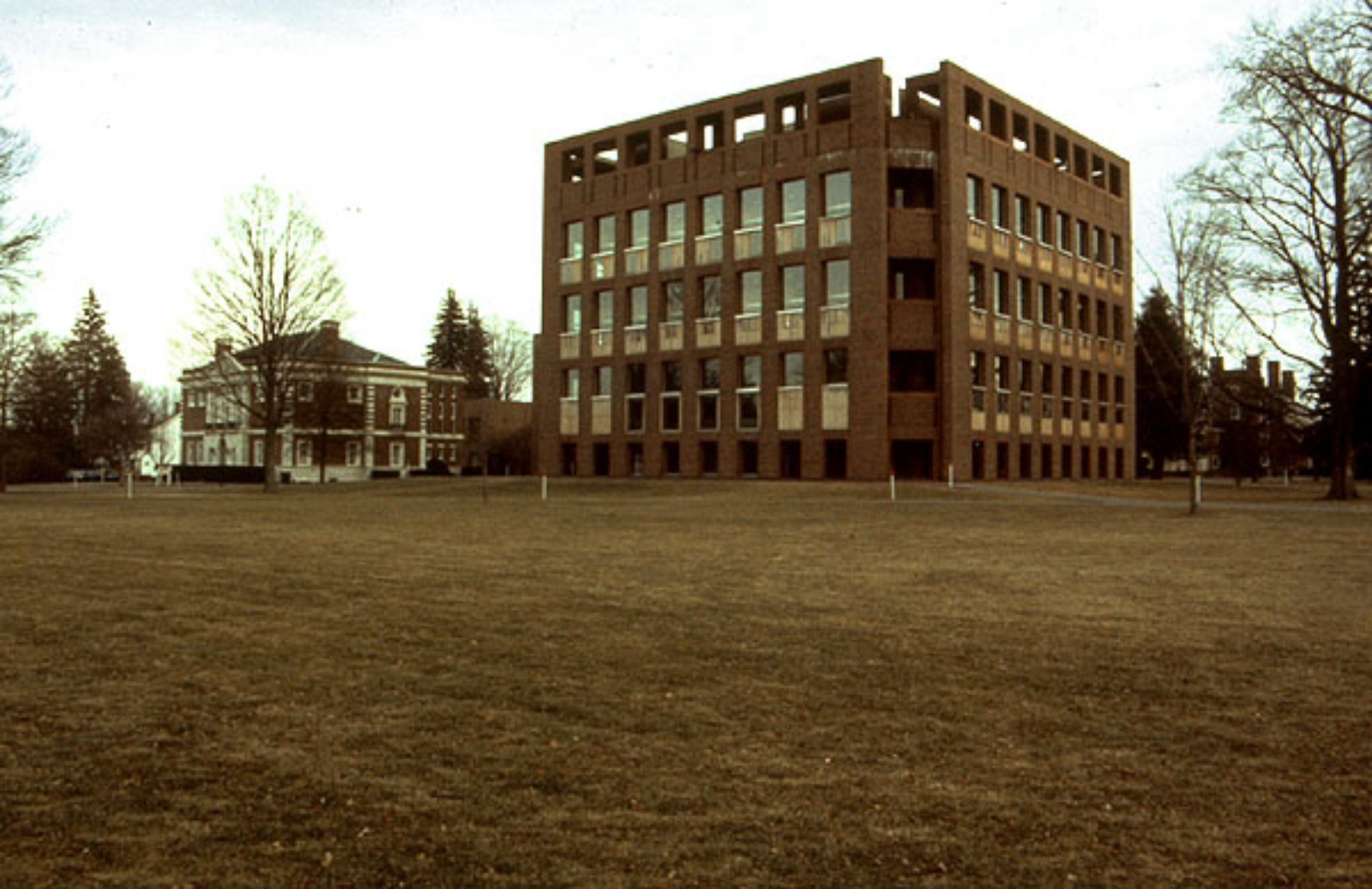
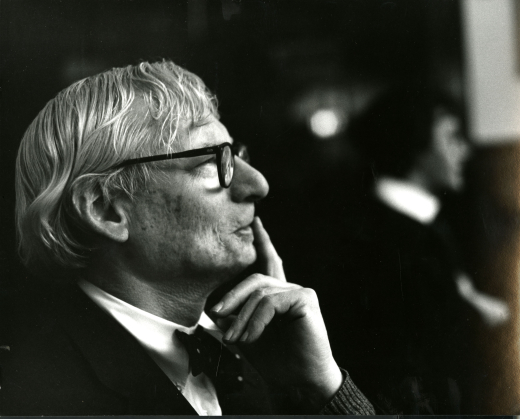
Built to serve the growing needs of Phillips Exeter Academy, a private boys school in the town of Exeter. The long tradition of inspiring architecture began with the original campus plan of Ralph Adams Cram. The wish for a library that would reflect the fundamental credo, "The End is in the Beginning" of the Academy led them seek out by committee an architect of inspiring imagination. The library was to be a Temple of Learning, and Louis I. Kahn was selected to fulfill the ideal of monastic meditation of knowledge. The school worked closely with Kahn to create and open space while providing private study areas in a brick building that would be sympathetic to the surrounding Georgian designs.
Geometric lines of a cube with chamfered corners made of primarily local red brick with teak and white oak detailing at windows. A nine story mass with eight bays on all sides. The vertical elements tapers slights toward the top reducing the impact of mass as well as indicating the structural load changes. The top floor is an open terrace which links to the ground floor arcade. The arcade that surrounds the entire ground floor obscures the entryway which is located at the north east corner. The chamfered corners offers a reveal to the shell of brick that holds the interior, again reducing the perception of bulk. The inconspicuous entrance opens to a large space, essentially a shaft of natural light at the center of the structure. Kahn often remarked that the plan was a "brick donut." The shaft, with four large circular openings, gives views of the library stacks on the upper floors as well as the structural joinery throughout the building. A grand travertine staircase leading to the library circulation desk; ascent to knowledge. The open shaft is surrounded by a hall, that is surrounded by library stacks, surrounded by a series of wooden reading carrols at windows. The idea of bringing The Book to The Light was part of the monastic tradition of libraries and symbolized the illumination within the volumes being read. Here wooden window shades on the lower portions allow the reader to comfortably adjust the light during the course of the day.

The building appearance is characterized by a limited palette of red brick, cast-in-place concrete, and white maple and teak finishes.
Set within the pastoral Academy campus the surrounding buildings are in the Georgian style. The surrounding town of Exeter is predominantly Colonial homes. The height of Kahn's proposed Exeter library was of concern to the neighborhood and required a zoning variance to proceed with the design.
The use of local red brick and poured concrete against basic geometric forms gives an almost primitive impression. The use of natural light and unified space is one of the critical design elements in all of Kahn's designs and here, after his work on the National Assembly in Dacca, India, the earthy quality of form and functions were satisfied. The modern practice of exposed structural elements creates open dialog between the user and his environment. The honest freedom of joints, connections and raw materials are the only decorations at Exeter.
Kahn took the responsibility of library design very seriously. The circulation of the plan is always dependent on the flow of user to books, to light. The process of learning among volumes is drawn from the deeply private meditative nature of the library. The look stacks are central to every interior view. As we collect our books we move toward private areas of study by bright windows where austere and thoughtful designs do not distract but rather enhance the process of study. The full intent of the design is dependent on its function and the social and philosophical integration of form and function is inextricably tied.
The Exeter library is an excellent example of geometrically based design of modern simplicity of materials that create space for the body and shape for the eye of the user.
Recipient of American Institute of Architects’ Twenty-five Year Award, 1997
The library is one of the most remarkable achievements of Kahn's work.
Brownlee, David Bruce, Louis I. Kahn : in the realm of architecture, Los Angeles, Museum of Contemporary Art, New York, Rizzoli, 1991.
Brownlee, David Bruce, Louis I. Kahn : in the realm of architecture, condensed edition, New York, NY, St. Martin’s Press], 1997.
Doshi, Balkrishna V., Le Corbusier and Louis I. Kahn : the acrobat and the yogi of architecture, Ahmedabad, India : Vastu Shilpa Foundation for Studies and Research in Environmental Design, [1993?].
Gast, Klaus-Peter, Louis I. Kahn : das Gesamtwerk = Complete Works, München : Deutsche Verlags-Anstalt, c2001.
Gast, Klaus-Peter, Louis I. Kahn : the idea of order, Boston, Mass. : Birkhäuser Verlag, 1998.
Goller, Bea, Kahn libraries = Kahn bibliotecas, Barcelona, Col.Legi d’Arquitectes de Catalunya, 1989.
Kahn, Louis I., The Louis I. Kahn archive : personal drawings : the completely illustrated catalogue of the drawings in the Louis I. Kahn Collection, University of Pennsylvania and Pennsylvania Historical and Museum Commission, Garland architectural archives, New York : Garland, 1987.
Johnson, Eugene J., Drawn from the source : the travel sketches of Louis I. Kahn, Williams College Museum of Art ; Cambridge, Mass. MIT Press, c1996.
Leslie, Thomas, Louis I. Kahn: building art, building science, New York : George Braziller, 2005.
Lobell, John, Between silence and light : spirit in the architecture of Louis I. Kahn, Boulder,1979.
Wiggins, Glenn E., Louis I. Kahn : the library at Phillips Exeter Academy, New York : Van Nostrand Reinhold, c1997.