Martin Luther King, Jr. Memorial Library

Commission Brief: Architect Mies van der Rohe was commissioned to design a structure to house the main branch of the District of Columbia Public Library. The commission followed a determination to replace the a white marble, Beaux Arts Carnegie Library located at 801 K Street at Mount Vernon Square. As with many other library modernization projects of the era, the Carnegie structure was deemed outdated and overcrowded.
Design Brief: The Fine Arts Commission, which oversaw the design competition, required a flexible interior plan and a capacity to create an addition when needed. In addition, they specified the need for prominent points of vertical communication in the form of elevators and dumbwaiters in the design of the library. Prior to this structure, the Commission had never approved a Modernist design for Washington D.C. The design entailed a 400,000 square ft., four story building of steel, glass, and brick. There was a potential fifth story addition prefigured in the design and three underground stories that included a parking level for 100 automobiles.
Building/Construction: Construction on the building began in 1968 and was scheduled to finish in 1970, however it continued through the summer of 1972. The architect Mies van der Rohe died in 1969 while the building was still under construction.
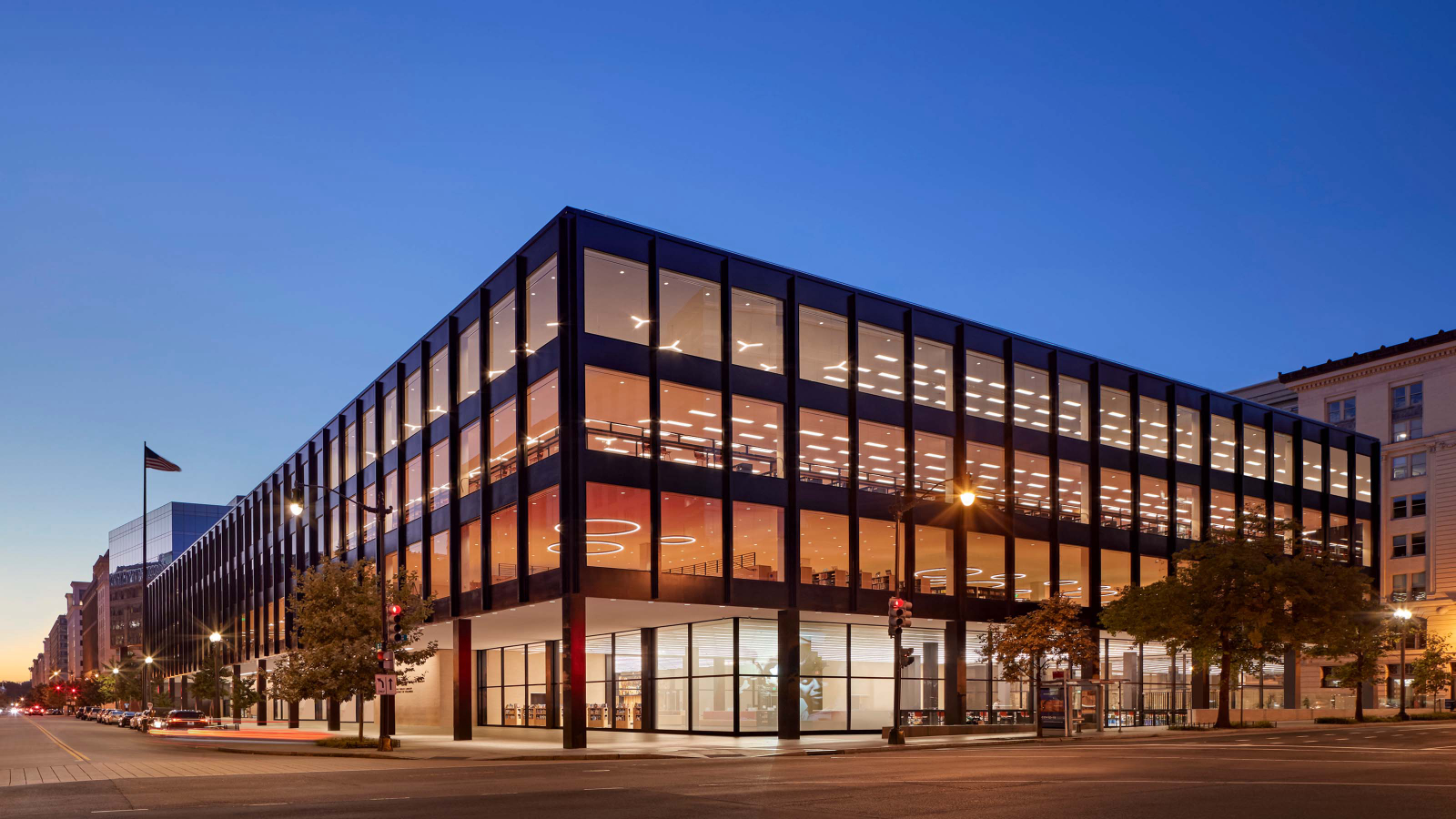
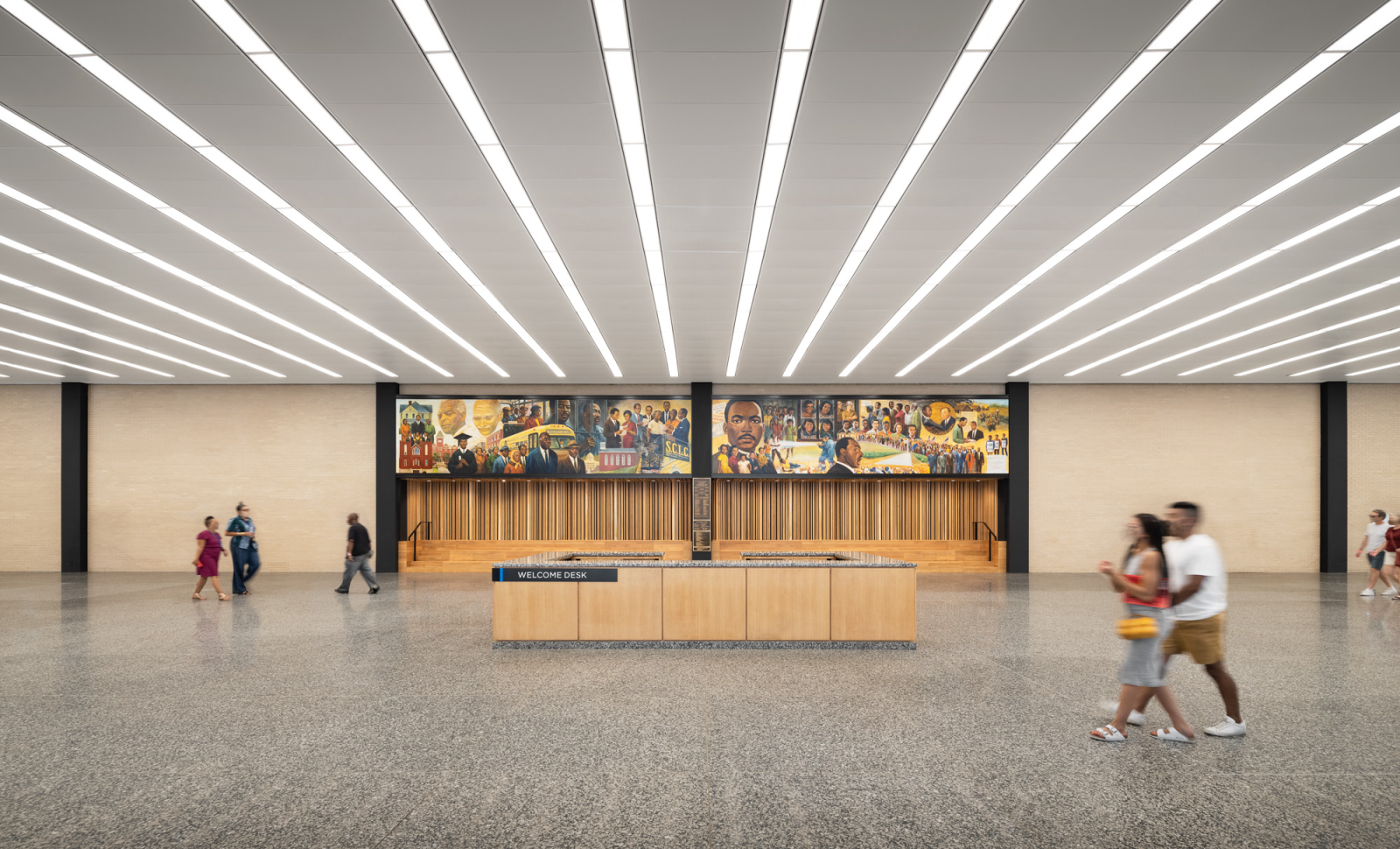
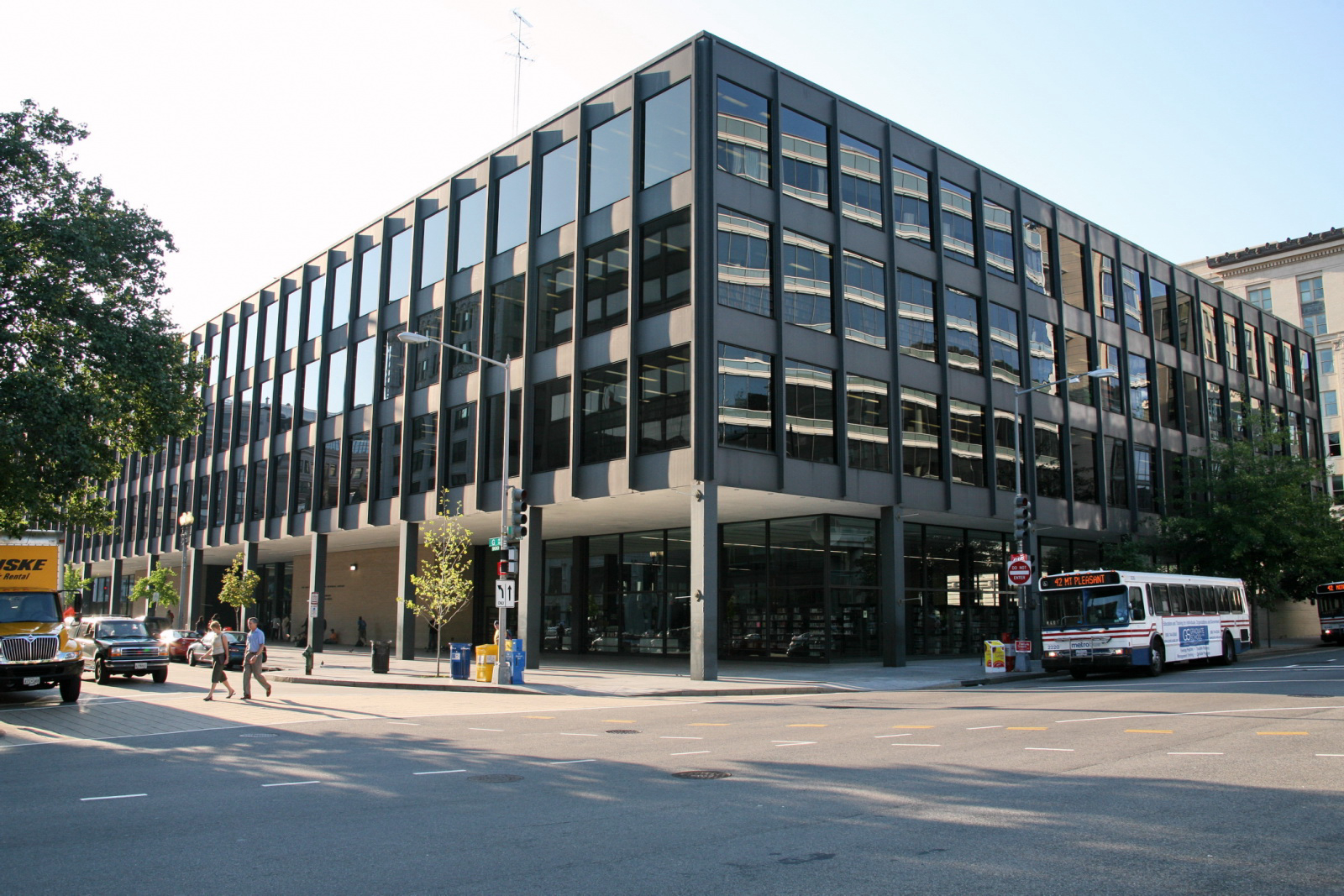
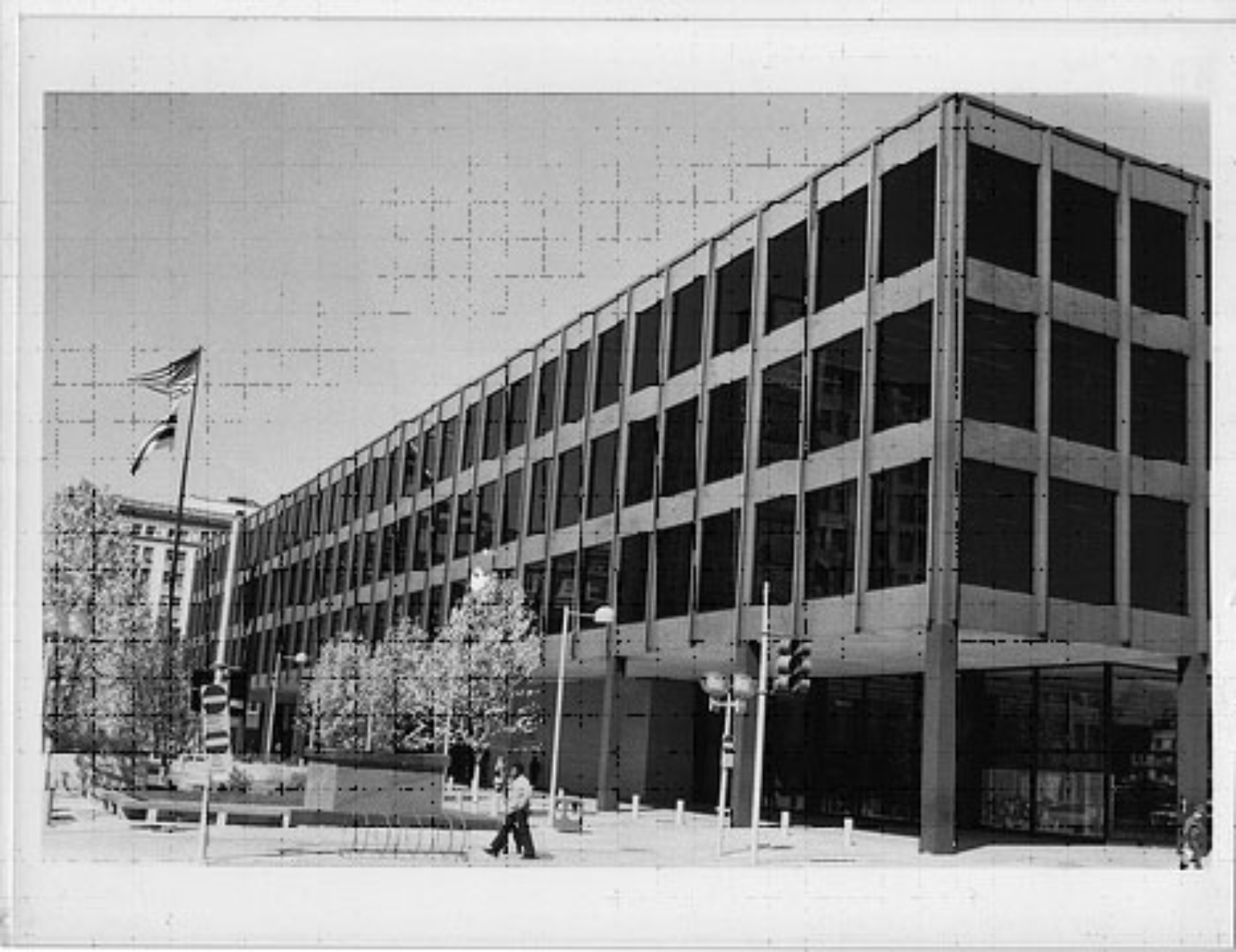
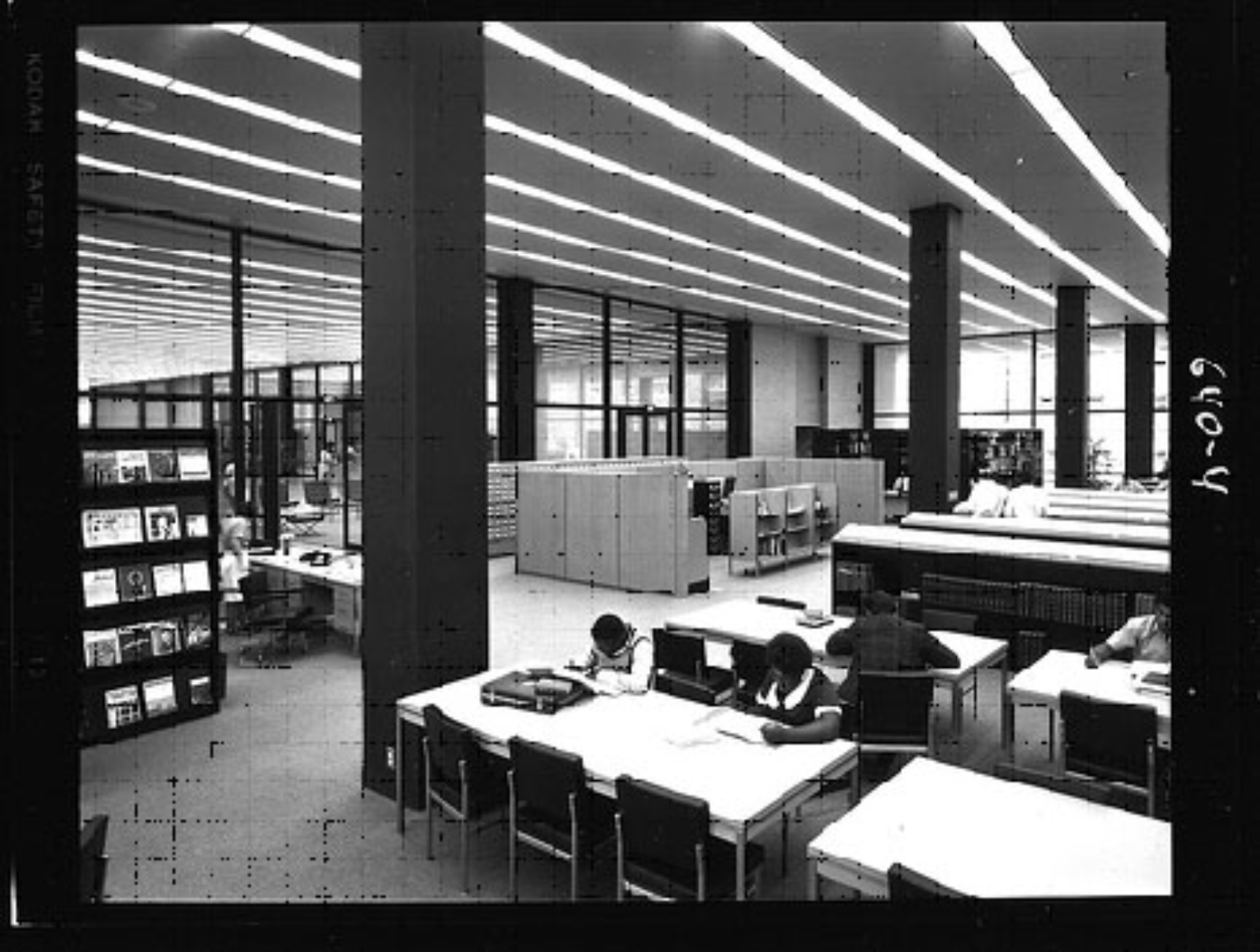
The Martin Luther King, Jr. Memorial Library is a rectangular 400,000 square foot building with four stories above ground and three below, with the bottom most level consisting of a parking garage. Composed of a steel frame, curtain wall, and columnar grid it incorporates all functions in a remarkably bilateral fashion. Built in the metropolitan environment of Washington D.C., the building was designed to serve the needs of library patrons, community groups, and librarians. As such, the structure concentrates upon vertical integration between all its levels, ensuring ease of flow and communication. Constructed of matte black steel, brick, and bronzed-tinted glass, the building exemplifies Mies van der Rohe’s mature sense of “Skin and Bones” architecture. Large tinted windows provide the primary conceptual statement of the building’s exterior, They create a shaded view of the books inside while simultaneously demonstrating the transparency of a public institution. With no major structural changes over time, the building remains a testament to the original time period and intent of the architect. As the sole library designed by Mies, the structure stands as his only interpretation of what the form of the library, and in turn the public realm of knowledge, entailed. With an open central space surrounded on all sides by book-stacks, offices, and meeting rooms, the library was outfitted with the most modern of technological conveniences at the time of its creation including book conveyor belts, pneumatic tubes, and dumbwaiters to speed conveyance from floor to floor. The building has few fixed walls and a very open floor plan, illustrating Mies’ conception that the public space would need to evolve over time to remain relevant.
Name(s) of surrounding area / building(s): The building is situated within the central Washington D.C. area, embedded between such iconic structures as the White House and Capitol Buildings. It sits at a diagonal across from the National Portrait Gallery / Smithsonian American Art Museum, an 1836 Greek-Revival building that is listed on the National Register of Historic Buildings.
Visual Relations: The building is situated within the classical milieu of Downtown Washington, D.C. and is in direct site-line with the National Portrait Gallery / Smithsonian.
Functional Relations: The buildings are not functionally related although both the library and museum serve educational purposes and are open to the public. Many of the downtown buildings are civic in nature and representative of both national and local governmental identity.
Other Relations: The buildings are related in their disparate architectural genesis, the Modern International Style of the library acts as a counterpoint to the Greek Revival Museum and for many the two buildings act as vying symbols of what downtown Washington D.C. should embody.
Completed Situation: When the building was completed it occupied almost the entire block between 9th and 10th Streets NW along G Street.
Original Situation or Character of Site: The original character of the site was urban in nature and was bought from several individuals in 1961 by the Library Board of Trustees. The buildings upon the street primarily housed small retail establishments. Completed in 1972, the building was envisioned and constructed in a markedly different technological realm than today. At the time, there was no provision for the Internet, and the library showcased prominent built in card catalogues to disseminate information. Today, patrons view these features as an indicator of the obsolescence of the building for use as an urban library. Further, with the disrepair of many of the building’s systems, many perceive the library as rundown and outmoded. The current mayor of Washington DC, and many others in the city government want to move the library from the Mies van der Rohe building to the site of the old Washington DC Convention Center several blocks away as part of a downtown redevelopment scheme. Declaring the need for a “twenty first century library”, the mayor has made the fate of the library a central issue. In this plan, the District of Columbia would lease the Mies building to a private owner. Many preservationists and civic groups decry the move and a civic fight has begun. In 2000, volunteer architects from the Washington D.C. chapter of the AIA commissioned a revitilization study that would alter the building’s interior and introduce a skylight to maintain its functional use as a library. This plan was never adopted and the current dialogue points to the city abandoning the building in 2007 or 2008. There is no indication, however, that the building will be torn down. Ultimately, the building is in a deep state of disrepair and regardless of its future function needs functional repair.
The building was designed to be the penultimate modern library. Equipped with state of the art technological services, a simple rectangular form, and large interior spaces broken by ordered, spare columns the building expressed the cool rationality of disciplined scholarship. The structural materials are successful and the framework of the building is technically laudable. The building exhibits experimentation and innovation in typology, with a myriad of functions flowing through a simple rectangular grid.
As a social expression, Martin Luther King Jr. Memorial Library was deeply innovative for its time. The building was the first Modernist structure commissioned by the Art Commission of the District of Columbia and represented a social turning point for a tradition bound civic definition of architecture in Washington, D.C. Located in the heart of the downtown area, and the successor to the classical Carnegie Library, the building was a conscious effort to commission an updated, innovative, and technologically advanced structure into the civic enterprise and fabric of Washington D.C. By inserting this building into the L’Enfant designed center of Washington D.C., the city’s government was striving for a new city expression. In addition, the building was Mies first and only application of his principles to a library and remains a testament to Modernist applications upon everyday, public life.
Mies designed the building to encapsulate a multitude of needs into a simple, clean form. The exterior, clad in tinted glass curtain walls and steel exudes a stylistically regulated and constrained façade that exhibits an unbroken rhythm upon the street. The rhythm is heightened, both literally and figuratively, by the existence of a colonnade on the street level of the building, where the steel frame rests upon regularly spaced thrusting columns. The desire for complex patterns of circulation, both of people and of books, dominates the concern of the interior, with all seven floors (four above ground three below) striving to create a vertical unity through regularly placed elevator shafts and stairwells, and a myriad of open spaces leading to rooms with specific collections and functional uses. Canonical Status: At the time of its inception, the building was lauded by both architecture critics and the general public as being a seamless application of Mies’ architectural principles to the concept of a library. The Washington Post architecture critic, Wolf Von Eckardt, stated that, “by the utter, pristine simplicity of the design…it is in itself a work of art, undoubtedly the best example of the art of modern architecture…in Washington D.C.” As the first library designed by Mies, too, it represented an innovative Modernist solution to the problem of a technologically and systematically designed space for late twentieth century society.
The Records of the Commission of Fine Arts holds correspondence pertaining to the commission and construction of the Martin Luther King, Jr. Memorial Library: The National Archives: Records of the Commission of Fine Arts. Washington D.C. National Archives and Records Administration 700 Pennsylvania Avenue, NW Washington, DC 20408-0001 There are many books written on the work of Mies van der Rohe, several notable of which are: Johnson, Philip C. Mies van der Rohe. New York: The Museum of Modern Art, 1947.
Zukowsky, John. Mies Reconsidered: His Career, Legacy, and Disciples. Chicago: Art Institute of Chicago, 1986.
Schulze, Franz. An Illustrated Catalogue of Mies van der Rohe Drawings in the Museum of Modern Art, Part II: 1938-1967, The American Work. New York: Garland Publishing, Inc: 1992. Pg. 355-415.
Carter, Peter. Mies van der Rohe At Work. London: Phaidon Press, 1999.