Cranbrook Academy of Art and Cranbrook Art Museum

Commission brief: Owner George Booth had been deeply impressed by his visit to the American Academy in Rome, and wished to construct a similar institution at Cranbrook. After seeing that Eliel Saarinen’s work for the Cranbrook School for Boys was extremely successful, Booth requested designs for the Academy of Art, which were to be loosely based on the educational ideas behind the American Academy in Rome.
Design brief: The owner first requested a design for the Cranbrook School for Boys, which had to include an older group of farm buildings on the site, and the new design needed to harmonize within and around the older group.
Chronology: 1925, Eliel Saarinen completed a master plan for the proposed art academy at Cranbrook. 1925, The first of the art buildings is completed, to house the Cranbrook Architectural Office, designed by Swanson and Booth. 1926-41, General dates for design and construction of main Academy of Art buildings, all designed by Eliel Saarinen. 1927-29, An addition to the Cranbrook Architectural Office is constructed, designed by Eliel Saarinen. 1928-30, Academy of Art Group Residences #1 and 2 constructed (Saarinen and Milles Houses); Eliel Saarinen architect. 1931-2, Academy Studio #4 built (Milles Studio) Eliel Saarinen, architect. 1932, Cranbrook Academy of Art formally established and welcomes students. Eliel Saarinen is named as its first president. 1932-3, Dormitory #2 at the Academy of Art constructed; Eliel Saarinen, architect. 1934, Pavilion converted into gallery and lecture hall for Cranbrook Academy of Art by replacing glass walls with masonry; Eliel Saarinen, architect. 1936, Dormitory #2, Cranbrook Academy of Art. Eliel Saarinen, architect. 1938, Dormitories #3 - #6, garage, Studios #5 and #6 erected at the Academy all designed by Eliel Saarinen. 1937-41, Planning and construction of Cranbrook Academy of Art Library and Museum, designed by Eliel Saarinen. 1942, Museum of the Cranbrook Academy of Art officially opens Academy given power to grant degrees under the educational laws of Michigan. 1956, Academy Studio #4 altered by R.H. Snyderin. 1957-58, Stairway addition to Academy of Art Library and Museum, designed by Henry Booth. 1985-6, De Salle Auditorium constructed; Robert Saarinen Swanson and George Zonars architects. 2000, Sculpture courtyard, painting studio and photography darkrooms at Cranbrook Academy of Art renovated by architect Quinn Evans. 2001-2, New Cranbrook Academy of Art Studio Building constructed, designed by Raphael Moneo. 2002, Renovation of ceramics, metal, and fiber departments at Cranbrook Academy of Art into 2D and 3D design departments; architect Quinn Evans
The Cranbrook Academy of Art is comprised of a complex of small buildings, arranged into a tight plan. The plan recalls English Gothic Revival quadrangles, as a mode of establishing an academic atmosphere, although the buildings themselves reflect no gothic details. As Eliel Saarinen himself described it, “The general scheme is arranged to obtain a good mass-effect and rhythm of line in the landscape and harmonious and varied place-formations in conformity with the character of the buildings. In suitable places a richer form treatment has been suggested to further support a varied picturesqueness as a deviation from the symmetry and seriousness of the basic motif. The ornamental treatment will grow out of the production of the Academy in these arts.”
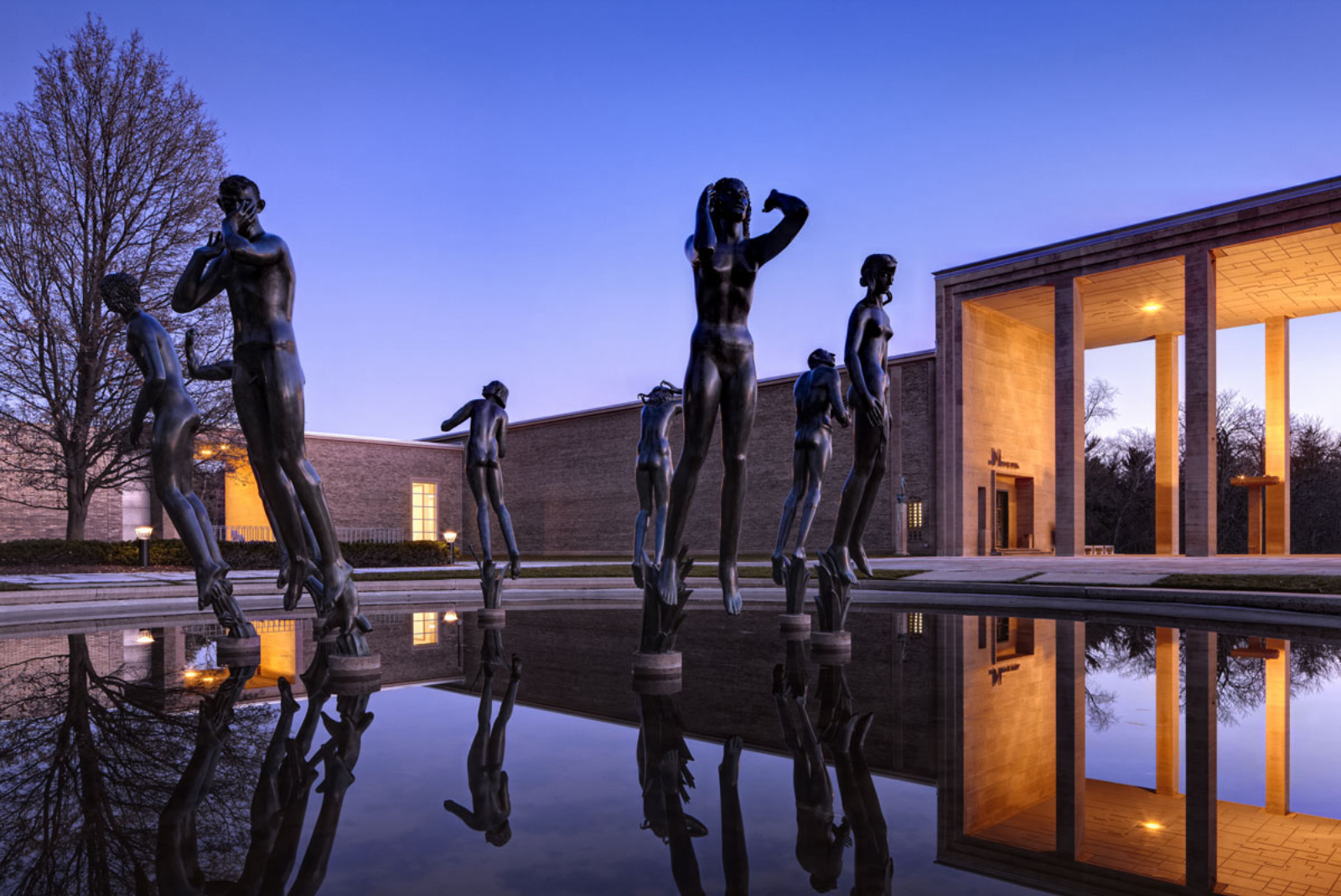
The Academy of Art buildings themselves are generally small in scale, and are comprised of a mixture of classroom, studio, office and residential spaces. The buildings are made of natural-colored brick and stone, and although not ostentatious, are nevertheless covered in and filled with Arts and Crafts detailing, most of which was done by arts at the Academy. The buildings are noted for their fine proportions and arrangement, use of patterns in the brickwork, and fine decorative details. The Academy structures were designed to fit in with the park-like surroundings, while providing an inspiring setting for creative artistic masterpieces. The slightly later museum building is described as “spare and almost Neo-classical,” and was Saarinen’s last great work at Cranbrook. Its front arcade serves as a front façade for the entire complex, with landscaped gardens gently sloping away from the massive columns, creating views to fountains, sculptures, and other campus buildings. The open portico of the main facade has “the unmistakable air of European abstracted classicism of the 1930’s.” Its materiality is consistent with the previous buildings at Cranbrook, but its scale is more monumental, allowing the building to have a more assertive presence on the campus.The Academy of Art has always been regarded as both the physical and emotional center of the Cranbrook campus. The character of Cranbrook is best summarized by the director of the Cranbrook Archives, who describes it as: Of all that can be said about Cranbrook, it is important to remember that there is nothing quite like it elsewhere. In part an artistic community, in part an educational center, in part a respected scientific institute, the Community is recognized the world over for the strength of its educational and cultural programs, the beauty of its grounds, and the exceptional architecture of its many buildings. What distinguishes Cranbrook from other educational complexes is not the types of institutions established--for there are great centers of learning the world over--but what was conceived and built on these grounds. At Cranbrook, institutions were conscientiously developed and designed to encourage individual growth and excellence by providing a built environment that promoted artistic, cultural, intellectual, and spiritual ideals. Here, students had only to look about them for proof that personal dreams and goals--no matter how grand--can be accomplished. Opportunity awaits everyone.
Names of surrounding area/buildings: Cranbrook Educational Community, including Cranbrook, Kingswood, and Brookside Schools, the Cranbrook Institute of Science, the President’s House, and various other academic, athletic, and service buildings. Visual relations: Between 1926 and 1943, nearly all of the main buildings at Cranbrook were designed and completed. Not only are these buildings from the same time period, but most were designed by the same architect, Eliel Saarinen. The campus was designed to be a cohesive whole, and all of the buildings relate to each other in terms of scale, style, and choice of materials. The Cranbrook Academy of Art and Cranbrook Art Museum form a main axis through the Cranbrook Campus, and are an important front façade for the complex, yet they still relate visually to the buildings around them.Functional relations: As an educational campus, all the buildings relate functionally in terms of their general uses. The Academy of Art and Cranbrook Art Museum operate independently, and do not share students with the other schools at Cranbrook, but still share the same general function. Other relations: The buildings all function together as an educational campus. Notes on context, indicating potential developments : A “Historical Preservation Student Design Competition” is currently underway, and winning designs will be chosen by a jury in June 2007. So although no development plans currently threaten these buildings, future changes are imminent. As this is a “historical preservation” competition, however, any proposed alterations or additions will hopefully be historically sympathetic to the existing building character.
These buildings were not technologically innovative, yet their design was a response to technologies of their time. The decorative, arts and crafts style used by the architect highlighted natural materials and handcraftsmanship, and was meant to stand in direct contrast to the mass-manufactured materials of the period.
According to the Cranbrook website, “In part an artistic community, in part an educational center, in part a respected scientific institute, the Community is recognized the world over for the strength of its educational and cultural programs, the beauty of its grounds, and the exceptional architecture of its many buildings.” These buildings have achieved a social impact simply because they house a respected university.
The Cranbrook Academy of Art was conceived as an American equivalent of the Bauhaus. Founder George Booth had a vision for his institution that was quite similar to Walter Gropius’ plan for the Bauhaus. Booth had “the idea of elevating public taste and joining the fine and applied arts as well as science and technology under one roof …” Cultural and artistic institutions of this level are fairly rare within the United States, particularly one with such a well-defined vision and a focus on the applied arts as equal to the fine arts.The buildings are stylistically influenced by classical modernism, but with a material emphasis on the arts and crafts movement. According to the Academy of Art’s website, “The Arts and Crafts movement appealed to George Booth aesthetically and morally. He hoped its influence would banish tasteless, mass-produced goods from American homes. He believed that craftsman-ship would result in superior products and provide the foundation for an ethically responsible life. Cranbrook would come to support those ideals and satisfy the desire of its founders to achieve something of lasting value and service.” Cranbrook was recognized as architectural interesting and innovative from its very inception. Plans were featured in American art and architecture periodicals before the buildings were even completed. Frank Lloyd Wright, a notoriously scathing architectural critic, admired the campus’ high quality building materials and detailed interiors and exteriors during a visit in the early 1940’s.
The buildings are generally considered works of the arts and crafts movement, but their architecture also takes hints from European Modernism and the Wrightian Prairie School. The Museum and Library building in particular was influenced not only by a general form of European abstracted classicism, but specifically relates to the Arts and Crafts classicism of 1920’s Vienna.
Cranbrook Archives 39221 Woodward Avenue, P.O. Box 801 Bloomfield Hills, MI 48303-0801
Director: Mark Coir, (248) 645-3154, mcoir@cranbrook.edu
The archives collection is cataloged, and can be searched through the Cranbrook Libraries’ online database http://libcat.cranbrook.edu. Unfortunately any intensive research must be undertaken in person at the archives, as most of the materials are not in circulation.
“Cranbrook“ American Magazine of Art. Volume 18 (August 1927), p. 403-413.
Christ-Janer, Albert. Eliel Saarinen. Chicago: The University of Chicago Press, 1948.
Eliel Saarinen Memorial Exhibition April 15 – May 6, 1951. Bloomfield Hills, Mich.: Cranbrook Academy of Art, 1951.
Design in America: The Cranbrook Vision 1925-1950. New York: Harry N. Abrams, Inc., Publishers in association with the Detroit Institute of Arts and the Metropolitan Museum of Art, 1983.
Pitts, Carolyn. “Cranbrook” Registration Form, National Register of Historic Places. National Park Service, 1989.
Cranbrook Academy of Art. Cranbrook Academy of Art. Bloomfield Hills, Mich. : The Academy, 2002.
Cranbrook Art Museum: 100 Treasures. Bloomfield Hills, Mich.: Cranbrook Art Museum, 2004.